The Binder and the Bottle
By Danny
The morning I decided to quit drinking, I couldn’t take a full breath.
I woke up on the bathroom floor at my mom’s house, still in my jeans, still in my binder. I’d slept in it, which you’re never supposed to do. Every breath stopped halfway, like something heavy was sitting on my chest. My ribs on the left side hurt so bad I thought one was broken.
I didn’t remember getting home. I found out later that my friend Kaylee drove me, got me through the back door, and left me where I fell because she couldn’t get me to stand up.
My mom found me at six in the morning when she got up for her shift. She didn’t yell. She just sat down on the edge of the tub, looked at me, and said, “Baby, what are you doing to yourself?”
I didn’t have an answer. I’d been trying not to need one for three years.
I’m Danny. I’m 19, I’m from a small town in south-central Kentucky, and I’m a trans guy. As of this week, I’ve been sober for seven months.
Where I’m From
People hear “rural Kentucky” and picture something out of a movie. That’s not my town.
My town is a Dollar General, two churches on the same road, a Dairy Queen, a high school where everybody knows everybody’s business, and a lot of people who’d give you the shirt off their back and then ask why you’re wearing it like that.
My mom is a CNA at a nursing home. My dad drives a truck and is gone four or five days a week. My little sister, Mallory, is fourteen and smarter than all of us. My mamaw lives ten minutes down the road and still sends me home with leftovers in Cool Whip containers.
Nobody chased me out of town or threw me out of the house. But you might be the only openly trans person you know, in a place where people still say “that girl” about you even after you’ve told them. When that’s your life, you start looking for a way to make it stop hurting. I found mine at a bonfire when I was sixteen.
The First Time It Got Quiet
If you’ve never had dysphoria, the closest I can get to describing it is this: it’s like wearing a costume you can’t take off, and everybody keeps complimenting the costume.
For me, it was mostly my chest. Then my voice, and the way people’s eyes would slide over me and decide “girl” before I’d said a word. It was being one of the guys at school, being in on the jokes, and then hearing someone’s girlfriend say, “She’s so funny.” All day long, there was a low hum in the back of my head telling me something was wrong.
The first party I went to was in a field off a gravel road, on land that belonged to somebody’s uncle. There was a fire, trucks parked in a half circle with the tailgates down, and somebody’s phone playing through a speaker. A guy I knew from Ag class handed me a red cup with something brown and something sweet in it.
I drank it because I wanted to look like I belonged. About twenty minutes later, the hum stopped.
For the first time in years, I wasn’t thinking about my chest. I wasn’t listening for the wrong pronoun. I was just standing by a fire, laughing, being loud, being Danny.
And the guys were different with me when everybody was drinking. Looser. They’d throw an arm around my shoulders, call me “bro,” and nobody corrected them. Drunk, I was one of them. Sober, I was the girl who hung out with them.
I didn’t decide to become a drinker. I decided I wanted to feel like that again. Those turned out to be the same decision.
The Binder
I bought my first binder when I was sixteen, a few months before that party. I ordered it online with money from mowing yards and had it shipped to Kaylee’s house so my mom wouldn’t see the package.
The first time I put it on, I stood in front of the mirror in Kaylee’s bathroom and cried. It wasn’t perfect. But my T-shirt hung straight down. I looked like a skinny guy. I looked like me.
I want to say this clearly, because I wish someone had said it to me: a binder made for binding is a good thing. It helped me survive high school. But it has rules, and the rules are there because your ribs and lungs are real.
Most binder makers and doctors will tell you to wear it no more than about eight hours a day. Don’t sleep in it. Don’t exercise hard in it. Take days off when you can. Never use duct tape or ACE bandages instead. If it hurts or you can’t breathe, take it off.
I knew all of that. I’d read it a dozen times. And I broke every single rule when I was drunk.
When you’re drinking, you don’t notice your body telling you something’s wrong. That’s the whole point of drinking, at least for me. So I’d put the binder on at seven in the morning for school, keep it on for work, keep it on at the party, and pass out in it. I’d wake up sore, with red marks under my arms, and not be able to take a deep breath until lunch.
Looking back, the binder and the bottle were doing the same job. They were both ways to not feel my body. One of them was keeping me alive. The other one was slowly hurting me. And I was using them together in a way that made both of them dangerous.
How It Got Worse
For a while it was just weekends. Then it was weekends and Wednesday nights. Then it was a pint of something in my truck “for the drive.”
I graduated high school, barely, and enrolled at the community college about forty minutes away to study IT. The first day, the professor read the roll from the system, and my legal name came out of her mouth in front of thirty people. I’d emailed the school about it. Somebody wrote back about a form. I never filled it out.
So I started skipping the classes where it happened. Then I started skipping the mornings after I’d been drinking, which was most mornings. By the middle of the second semester, I just stopped going. I didn’t officially withdraw. I disappeared, which I was getting good at.
I picked up hours at a tire shop. The guys there called me Danny and didn’t ask questions. On Fridays, we’d sit on upside-down buckets in the bay and drink beer out of a cooler.
That’s the hard thing about drinking that nobody tells you. It wasn’t all bad. Some of the best moments I had as a guy, the moments where I felt seen as one, happened with a drink in my hand. When you quit, you’re not just giving up alcohol. You feel like you’re giving up the only place you ever got to be yourself.
The Bathroom Floor
So that’s where I was on the morning my mom found me.
She took me to urgent care. I had to take my binder off in front of the nurse because the doctor needed to listen to my lungs and press on my ribs. I was hungover and crying, and the nurse just said, “Okay, honey, we’re almost done,” like it was nothing.
My ribs weren’t broken. The doctor said the cartilage around them was inflamed and bruised, and it would take weeks to heal. He asked how often I wore the binder and whether I slept in it. Then he asked how much I drank.
I lied about the second one. He looked at me like he knew.
He gave me a printout about binder safety and a phone number for a substance use helpline. I folded both of them up and put them in my wallet. That’s where they stayed for two weeks.
In the truck on the way home, my mom didn’t turn the radio on. Finally she said, “I don’t understand all of this. The boy stuff. I’m trying. But I understand drinking. Your papaw drank. I watched what it did.”
I’d never known that. Nobody in our family talked about it.
“I’m not losing you to it,” she said. “I don’t care what you call yourself. I’m not losing you.”
It was the first time she’d ever said anything close to accepting it. It took me lying on a bathroom floor for her to get there, and it took her saying it for me to get honest.
The First Weeks
I called the helpline from the tire shop parking lot. The woman who answered asked how much I drank, how often, and whether I’d ever gotten the shakes when I stopped. She told me that for people who drink heavily every day, quitting suddenly can be dangerous and should be done with a doctor. I didn’t know that. If you drink every day, talk to a doctor before you stop.
The first weekend was the worst. Friday night, Kaylee texted me a picture of the bonfire. I sat in my room and felt my whole body itch. I wasn’t craving the taste. I was craving the quiet.
Without the alcohol, the hum came back, and it came back loud.
Facing My Body Without a Buffer
This is the part nobody prepares you for.
When I was drinking, I could go weeks without really looking at myself. I showered fast with the lights off. I changed with my back to the mirror. If I felt the dysphoria creeping in, I knew exactly how to make it go away.
Sober, there was nowhere to go. I had to take my binder off every night, because my ribs were healing and I’d promised the doctor. That meant sitting in my room for hours in a sports bra and a baggy hoodie, feeling every inch of my chest. Sometimes I’d just lie on the floor and stare at the ceiling fan until it was late enough to sleep.
Some nights, I hated my body more sober than I ever did drunk. I’m not going to pretend otherwise.
But something else started happening too. Because I wasn’t numbing everything, I could actually figure out what I needed.
I realized I didn’t hate my whole body. I hated my chest. I hated how my voice sounded on a voicemail. I hated being called “ma’am” at the drive-thru. But I liked my hands. I liked my shoulders, which had gotten bigger from lifting tires. I liked my haircut. Drunk, all of it blurred into one big feeling of wrongness. Sober, I could pull it apart into pieces, and pieces are easier to deal with.
I started keeping a list on my phone called “Things That Help.” A sports bra under a flannel on days off. Lifting at the gym in town early, when it’s empty. Saying my own name out loud.
None of it fixed the dysphoria. But I could get through a day without drinking to escape it. Then I could get through another one.
Finding People
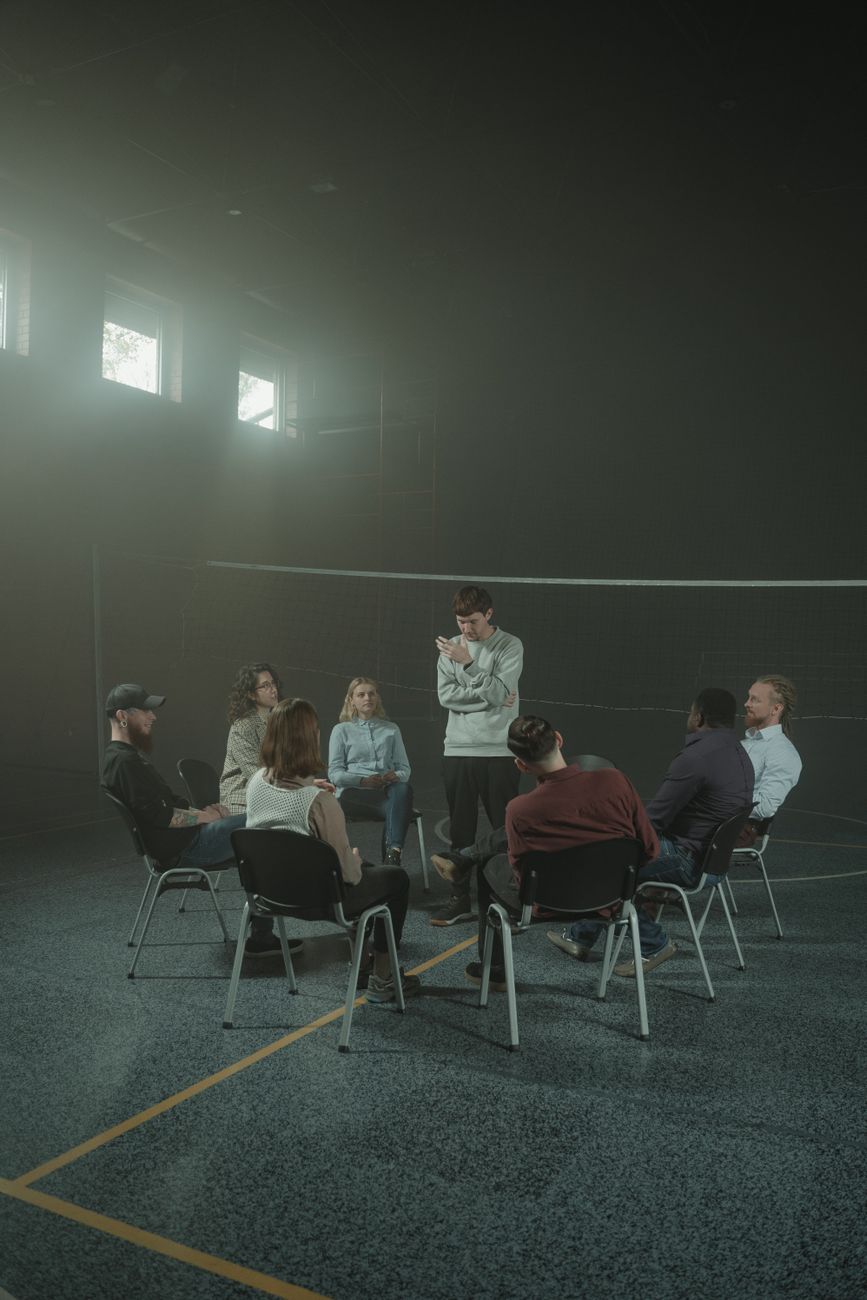
The first recovery meeting I went to was in a church basement in the next town over. Folding chairs, burnt coffee, a box of donuts, about twelve people.
I almost left in the parking lot. I was sure somebody would look at me and figure it out, and that I’d have to explain myself to a room full of strangers on top of everything else.
What actually happened was an older man named Ray, who’d been sober longer than I’d been alive, shook my hand at the door and said, “Glad you’re here, son.”
I don’t think Ray had any idea what that meant to me. He just saw a scared kid in a hoodie and called him son.
That meeting isn’t perfect. Sometimes there’s a lot of God talk I don’t know what to do with. But nobody there cared about my body. They cared whether I came back next week.
A few weeks later, I found an online recovery meeting for LGBTQ people that meets late at night. That’s where I met other trans guys who’d used drinking the same way I did. One of them said, “We weren’t drinking to party. We were drinking to disappear.” I wrote that on a sticky note and put it on my mirror.
I go to both meetings now. Ray’s room gives me a place in my town. The online room gives me people who understand the part Ray doesn’t.
What My Family Is Learning
My mom still slips up on my name sometimes. When she does, she corrects herself, which is more than she used to do.
She drove me to my first appointment at a clinic in Louisville that provides gender-affirming care for adults. It’s more than two hours each way. We stopped at a gas station on the way back, and she bought me an Ale-8 without asking, the same way she used to when I was little.
I’m on a waiting list to start testosterone. The clinic told me they wanted me to have some steady sobriety time first so we can see how I’m actually doing, and I understand why. I also want to make that decision clear-headed. I’ve spent enough time doing things to my body without thinking.
My dad hasn’t said much about any of it. Last month he put new brakes on my truck in the driveway and called me over to watch. “You should know how to do this yourself,” he said.
I think that’s his version of trying.
Mallory has been on my side from the start. She calls me her brother to anybody who’ll listen, including our mamaw, who told her not to be smart.
Seven Months
Here’s what sobriety looks like for me right now.
I wear my binder for work and take it off when I get home. I don’t sleep in it anymore, ever. My ribs healed, and I’d like to keep them that way.
I still have bad days, when the dysphoria is so loud I want to crawl out of my skin. On those days, I call somebody from the meeting, or I go lift, or I text Kaylee, who quit drinking two months after I did.
I’m going to re-enroll at the community college in the spring. This time I called the office and had someone walk me through the preferred name form. It took ten minutes. Two years ago, that call felt impossible.
Last weekend, I went to a bonfire for the first time since I got sober. Same field, same trucks, same fire. I almost didn’t go. I sat in my truck for a while with the engine off.
Then I got out and walked over with a cold bottle of Ale-8 in my hand. Somebody threw an arm over my shoulder and said, “Danny! Bro, where you been?”
And I realized I didn’t need to be drunk for that to happen. It was always going to happen. I was the one who couldn’t feel it.
The hum was still there in the back of my head. It probably will be for a while. But I could hear the fire, and the music, and my friends. I could feel the cold bottle in my hand and the heat on my face, and I was there for all of it.
That’s what I’m learning sobriety means. It’s not that my body stops being hard to live in. It’s that I’m finally living in it.
Editor’s note: Danny is a composite character based on common experiences of trans men dealing with dysphoria and substance use. If you’re struggling with drinking, the SAMHSA National Helpline (1-800-662-4357) is free, confidential, and open 24/7. If you drink heavily every day, talk to a doctor before you stop, because alcohol withdrawal can be dangerous.