By Robin
I used to think van life was a personality type.
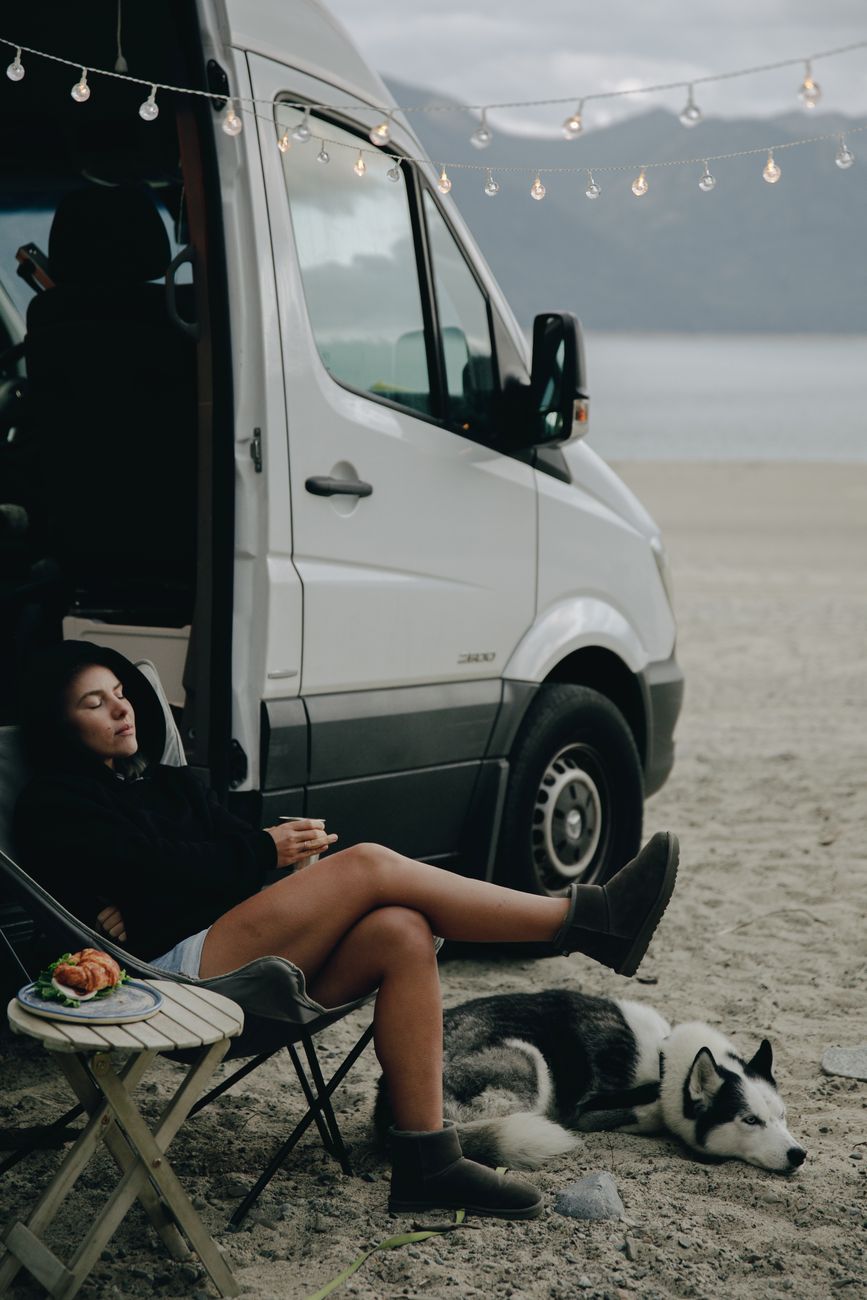
You know the version: linen shirt, enamel mug, golden retriever asleep under a wool blanket. A woman with sun-bleached hair opens the back doors at sunrise and looks out over a desert valley. Someone makes coffee with a tiny pour-over setup while a playlist called “Slow Mornings” plays in the background. There’s always a mountain, always a clean window, always enough battery to charge a laptop.
Then I lost my tech job.
I’m 33, nonbinary and transmasc, white, college-educated, and formerly employed in a job that sounded impressive at parties but mostly involved sitting in a chair under fluorescent lights, explaining software to other people who sat in chairs under fluorescent lights. I lived in the Pacific Northwest, where the rent was offensive but the coffee was good and everyone had an opinion about moss.
When the layoffs came, I told myself I was going to make something meaningful out of it.
I had some savings. I had a used cargo van I’d been slowly converting on weekends. I had enough confidence—or denial—to believe that losing my job could become a story about freedom. Maybe I’d freelance. Maybe I’d build a portfolio. Maybe I’d travel, reset, become the kind of person who knew where to find free campsites without checking three apps and a Reddit thread.
I posted a photo of the van on Instagram after I finished the bed platform.
“New chapter,” I wrote.
What I did not post was the receipt for the lumber, the panic I felt after looking at my checking account, or the fact that I had spent the previous night crying in the parking lot of a hardware store because I could not figure out how to wire a fuse panel.
That was six months ago.
I’m writing this from the driver’s seat because it’s raining hard enough that the sound on the roof makes it difficult to think. I’m parked somewhere legal-ish outside Portland, though “legal-ish” is one of the core emotional states of van life. My socks are damp. My phone battery is at 18 percent. I have a bag of laundry behind the passenger seat that has become less of a bag and more of a biome.
The van is not romantic. Sometimes it is beautiful. Those are different things.
The Version You See Online
Instagram van life is a genre built around selective evidence.
You see the cliffside campsite. You do not see the hour spent driving in circles because the road to the campsite was washed out. You see the neatly made bed, the string lights, the book resting on a pillow. You do not see the condensation that collects overnight and turns the inside of the windows into a weather system.
You see someone cooking pasta beside a lake. You do not see them trying to clean a pot with two cups of water because they are rationing their tank until they can find a place to refill it.
You see freedom. You do not see logistics.
The aesthetic is powerful because it promises an escape from the things many of us are tired of: rent increases, work Slack, office politics, commutes, and the feeling that life is happening somewhere outside the calendar invite. The van becomes a symbol. It says: I opted out. I need less. I can go anywhere.
But a van is not an escape from capitalism. It is just a smaller, more mobile place to experience it.
Gas costs money. Insurance costs money. Repairs cost money. Public showers cost money. Campsites cost money. Groceries cost money, especially when you do not have a full kitchen or the ability to buy in bulk. Reliable cell service costs money because, if you are trying to work remotely, “going off-grid” is mostly just another phrase for “not making rent.”
And when the van breaks down, there is no landlord to call. There is only you, your roadside-assistance plan, and the particular dread of hearing a mechanic say, “Well, that’s going to be expensive.”
Losing a Job Changes the Story
I used to daydream about quitting my job to live in the van.
That sentence feels embarrassing now.
There is a huge difference between choosing uncertainty and being pushed into it. When van life is a vacation, an adventure, or a deliberate lifestyle shift supported by savings, it can feel expansive. When it is the most affordable option after a layoff, it can feel like you are trying to turn instability into a personal brand.
I did not want to tell people I was living in a van because I had lost my job. I wanted to tell them I was “traveling.” I wanted to make it sound intentional, because intentionality is socially legible. It is easier for people to hear that you are taking a sabbatical than that your health insurance disappeared and your rent became impossible.
That distinction matters.
There is a growing cultural appetite for stories about living with less. Sometimes those stories are useful. They can challenge the assumption that a bigger home, newer car, or higher salary automatically creates a better life. But they can also romanticize precarity. They can make resourcefulness look like a hobby instead of a survival skill.
Not everyone in a van is chasing a sunset. Some people are escaping an unsafe home. Some are avoiding eviction. Some are working full time and still cannot afford an apartment. Some are queer or trans and have been pushed out of family housing or unstable roommate situations. Some are just one medical bill, one rent hike, or one job loss away from sleeping in their car.
The glossy version of van life rarely makes room for that.
The Reality of Small Space
The van is about 70 square feet, depending on how generously you measure the parts occupied by storage bins, wet shoes, and existential dread.
In that space, every object has a job. A spoon cannot just be a spoon. It has to be the right spoon: durable, washable, unlikely to disappear under the bed platform. A jacket cannot just be a jacket. It needs to work for rain, cold, job interviews, and the inevitable moment when you are standing outside a grocery store trying to look like someone who has not been sleeping in a vehicle.
Privacy becomes precious.
There is nowhere to go when you need to be alone, because you are always already in your room. There is nowhere to pace during an anxious phone call. No bathroom down the hall. No living room with a door you can close. When I am sick, the van feels especially small. When I am dysphoric, it can feel like there is nowhere to put that feeling.
Being transmasc adds another layer of calculation to ordinary routines. Which gym shower feels safest? Which public restroom has the least chance of becoming a confrontation? What do I say if someone asks why I am parked here? How much information do I owe a stranger with a flashlight tapping on my window at 2 a.m.?
Most nights are uneventful. But safety is not just whether something happens. It is the energy required to stay alert to the possibility that it could.
And then there is the weather.
The Pacific Northwest teaches you quickly that rain is not one thing. There is soft rain, cold rain, sideways rain, rain that somehow gets inside despite your best efforts, and rain that makes your entire van smell like damp fabric and regret. People online love to talk about “cozy rainy days” in vans. I would like to personally invite them to spend three consecutive days trying to dry a towel without access to a dryer.
There Are Good Moments
I do not want to overcorrect and pretend it is all misery.
There have been mornings when I woke up near a river, opened the doors, and felt so briefly, so completely lucky that I almost understood the Instagram version. I have watched fog lift off pine trees while making cheap instant coffee. I have met people at trailheads and campgrounds who offered practical kindness without asking for my life story. I have learned how little I need to make dinner, sleep comfortably, and feel momentarily at home.
Living in a van has also made certain things clearer.
I know exactly how much water I use. I notice every unnecessary purchase. I call friends more often because I cannot accidentally substitute proximity for connection. I have become less attached to the idea that adulthood means owning the correct furniture.
But none of those lessons are exclusive to van life. You do not need a cargo van, an electrical system, and a growing distrust of municipal parking enforcement to learn what matters to you.
That is the part I wish more people said out loud.
Freedom Needs a Safety Net
The people who make van life look effortless usually have something behind the frame: money, family support, a remote job, a partner, an address they can use, a place to return to, a body that can handle the physical labor, or enough social privilege to be read as an adventurous traveler rather than someone in crisis.
I have some of those advantages. I am white. I have an education. I have friends who would let me sleep on their couch if I needed to. I know how to talk to customer service representatives, mechanics, and hiring managers in a way that makes people take me seriously. Those things have made this easier than it could have been.
And it is still hard.
So no, van life is not romantic. Not reliably. Not in the way it is sold to us.
It can be beautiful, occasionally. It can be practical. It can be a temporary bridge, a deliberate adventure, or a way to reduce expenses while rebuilding. But it is not inherently freeing, and it is not proof that someone has escaped the system. Sometimes it is just a person trying to make a difficult situation survivable.
I am still applying for jobs. I am still trying to build a life that includes a mailing address, reliable heat, and enough room to leave my laundry somewhere that is not next to my food.
Maybe someday I will look back on this period as a turning point. Maybe I will tell a cleaned-up version of the story, with the scenic photos and the hard-won wisdom.
But for now, the van smells like wet socks, the rain is getting louder, and I need to figure out where I can park tonight.
That is the truth.