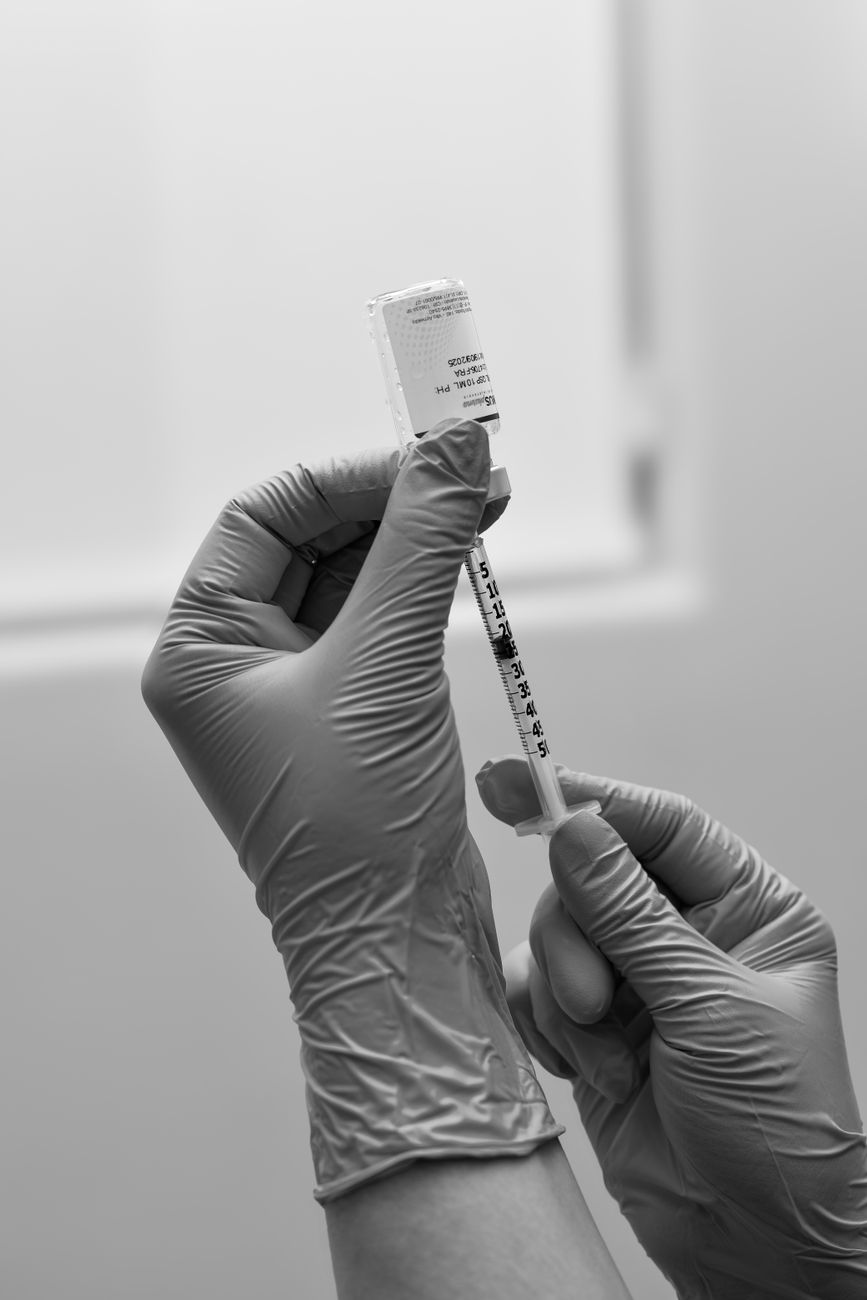
Injectable testosterone is one of the most common ways trans men and other transmasculine people take masculinizing hormone therapy. For many people, the intimidating part isn’t testosterone itself; it’s learning how to safely prepare a syringe and give yourself an injection.
There are two primary injection methods: subcutaneous (SubQ or SQ) injections, which place testosterone in the fatty tissue beneath the skin, and intramuscular (IM) injections, which place it deeper into muscle. Both routes are used for injectable testosterone in gender-affirming care. UCSF notes that although injectable testosterone products have traditionally been labeled for intramuscular administration, subcutaneous administration has also been widely used with good efficacy and patient satisfaction.
This guide explains what the two methods have in common, how they differ, how to prepare for an injection, and what to expect afterward.
Important: This guide is intended for people who have already been prescribed injectable testosterone and approved or trained to self-inject. Follow the dose, schedule, route, supplies, and instructions provided by your prescriber or pharmacist. Do not switch between SubQ and IM, alter your dose, or substitute injection supplies without confirming that change with your healthcare provider.
Table of Contents
- SubQ vs. IM Testosterone Injections
- What You’ll Need
- Before You Start
- Step 1: Prepare the Testosterone
- Step 2: Choose Your Injection Site
- Step 3: Clean the Injection Site
- Step 4A: Giving a SubQ Testosterone Injection
- Step 4B: Giving an IM Testosterone Injection
- Do You Need to Aspirate?
- After the Injection
- What Can Be Normal After a Testosterone Shot?
- When to Contact a Healthcare Provider
- What If My Shot Went Into the Wrong Tissue Layer?
- Making Testosterone Shots Less Intimidating
- SubQ or IM: Which Should You Choose?
- Frequently Asked Questions
- Helpful Links
SubQ vs. IM Testosterone Injections
The biggest difference is where the medication is deposited.
| Subcutaneous (SubQ) | Intramuscular (IM) | |
|---|---|---|
| Medication goes into | Fat beneath the skin | Muscle tissue |
| Needle | Generally shorter and smaller | Generally longer |
| Typical angle | 45° or 90°, depending on technique and supplies | 90° |
| Common self-injection areas | Abdomen or thigh | Outer-middle thigh |
| Tissue handling | Usually pinch a fold of fatty tissue | Skin is generally held flat |
| Main advantage | Smaller needle and often easier self-injection | Long-established injection method |
Planned Parenthood‘s current self-injection materials describe IM injections as going directly into muscle at a 90-degree angle, while SubQ injections enter the fatty tissue immediately under the skin and may be performed at either 45 or 90 degrees depending on the technique being used.
Neither route is inherently the “more masculine” or more legitimate way to take testosterone.
What You’ll Need
Use the supplies prescribed or recommended for your specific testosterone and injection method. Needle length and gauge can vary according to route, body, medication, and clinician preference, so this guide intentionally doesn’t prescribe a universal needle size.
Before starting, gather:
- Your prescribed testosterone vial
- A sterile syringe
- The needle prescribed for drawing medication from the vial, if separate
- The needle prescribed for the injection
- Alcohol pads
- Gauze or a small bandage
- An FDA-cleared sharps container, if possible
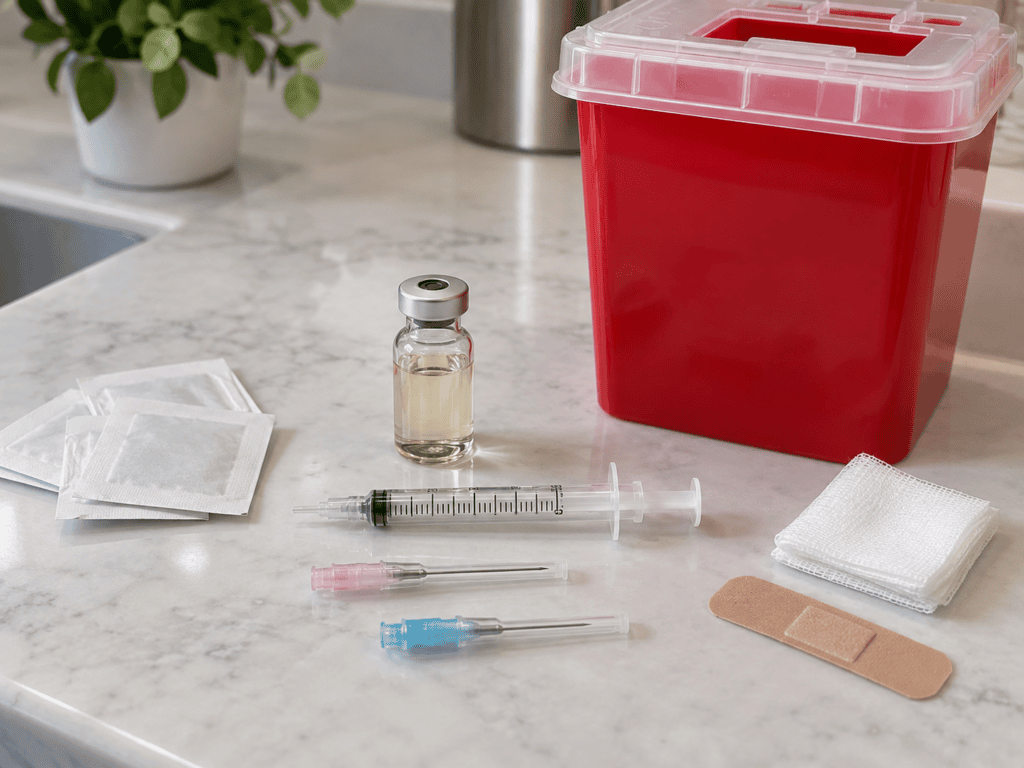
The FDA recommends placing used needles and other sharps directly into an appropriate sharps container after use. If an FDA-cleared container isn’t available, a heavy-duty plastic household container with a tight-fitting, puncture-resistant lid may be an acceptable alternative depending on local disposal rules.
Before You Start
Choose a clean, stable workspace with enough room to lay out your supplies.
Wash your hands thoroughly and dry them.
Check your testosterone vial. Confirm that you have the correct medication and concentration, and check the expiration date. If the medication appears unexpectedly contaminated, contains unusual particles, or looks substantially different from normal, don’t use it until you’ve checked with a pharmacist or prescriber.
Never share needles, syringes, or medication intended only for you. CDC safe-injection guidance emphasizes using a new sterile needle and syringe for every injection and avoiding contamination of medication vials.
Step 1: Prepare the Testosterone
Remove the protective cap from a new vial if necessary. If the rubber stopper has already been exposed, wipe it with a fresh alcohol pad and allow it to dry.
Attach your drawing needle (a thicker needle, generally 18 gauge or similar) to the syringe, if your supplies use a separate drawing needle.
Pull air into the syringe as you were taught, generally corresponding to the amount of medication you will withdraw. Insert the needle through the rubber stopper and introduce the air into the vial.
Turn the vial upside down while keeping the needle tip within the liquid. Slowly withdraw your prescribed volume of testosterone.
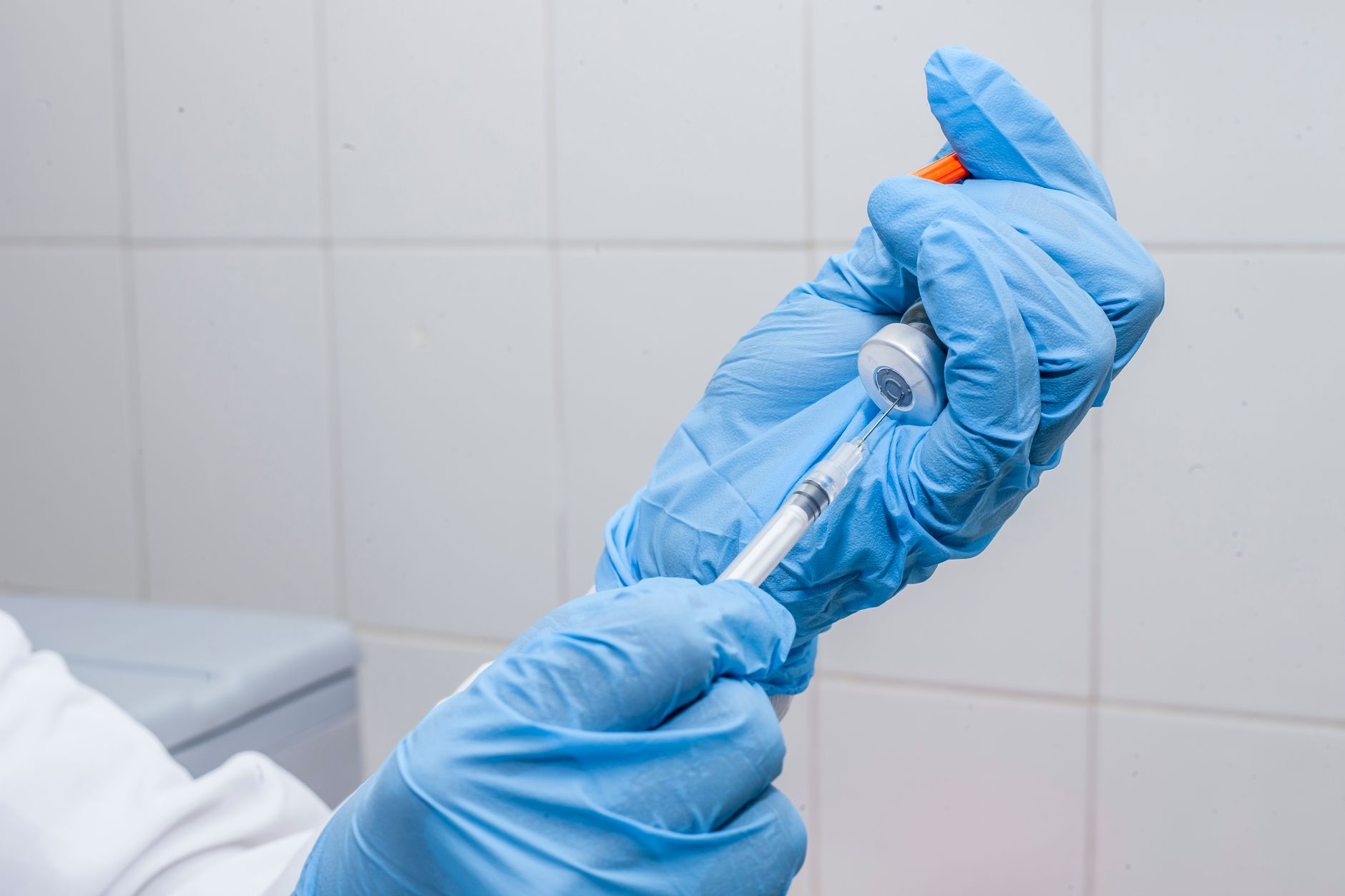
Because testosterone formulations can be fairly thick, drawing the medication slowly is normal.
Check the syringe for large air bubbles. If necessary, gently tap the barrel so the bubbles rise and adjust the syringe as you were taught until the prescribed amount remains.
If you use a different needle to inject, remove the drawing needle and attach a new sterile injection needle without touching the sterile parts. The size of the injecting needle (both length and width) varies by prescriber, with smaller sizes generally being used for subq injections. The larger the needle, the faster you are able to administer the dose. The standard range in size varying from 21 gauge to 29 gauge, though this may vary.
Step 2: Choose Your Injection Site
This is where the SubQ and IM techniques begin to differ.
For a SubQ Injection
SubQ medication is placed into the layer of fatty tissue underneath the skin. Common self-injection locations described in gender-affirming injection guides include the abdomen and thighs.
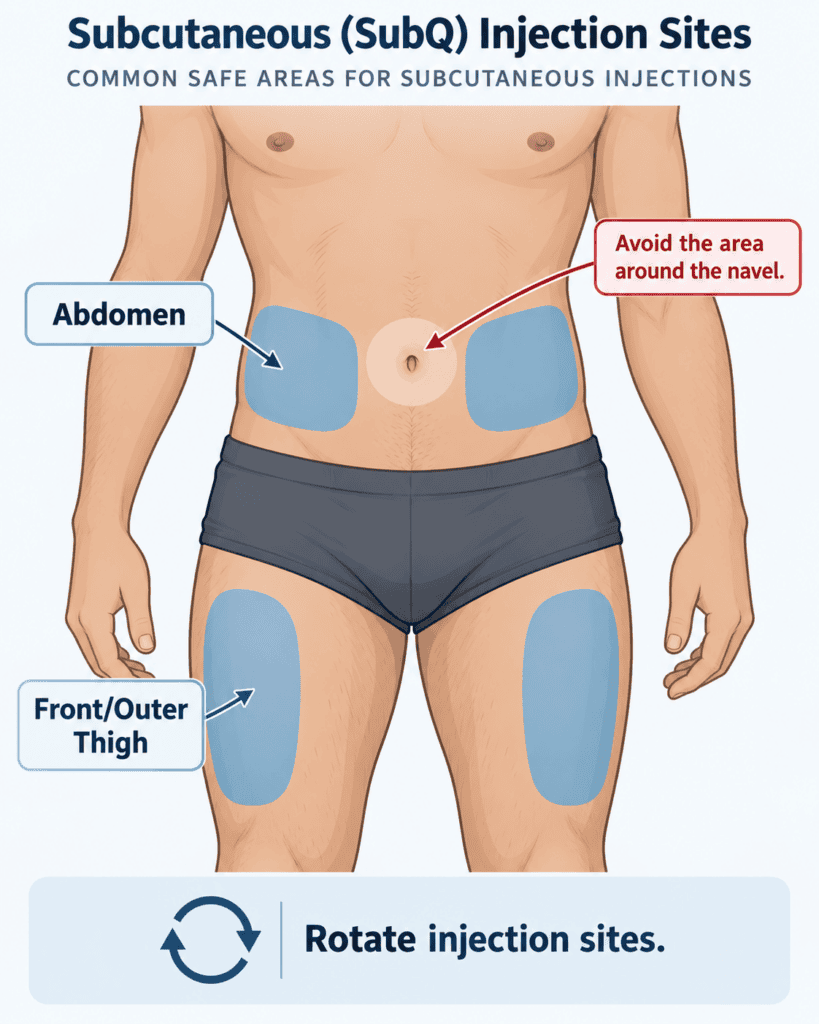
Your clinician may recommend a particular region based on your body and technique.
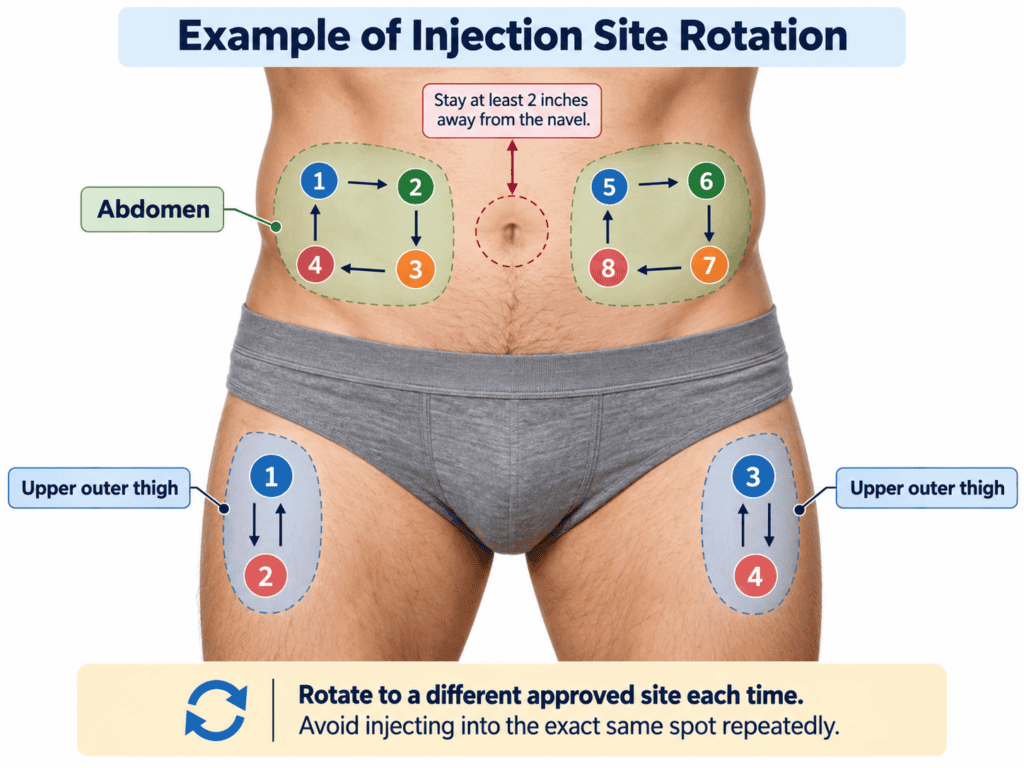
Rotate your injection sites rather than repeatedly injecting the exact same location. Avoid areas that are bruised, irritated, infected, scarred, unusually tender, or otherwise abnormal.
For an IM Injection
IM testosterone is delivered into muscle.
For people giving themselves an injection, the vastus lateralis muscle of the thigh is a commonly taught location. Planned Parenthood’s injection guide describes locating the site by imagining the upper thigh divided into a three-by-three grid and using the outer-middle portion.
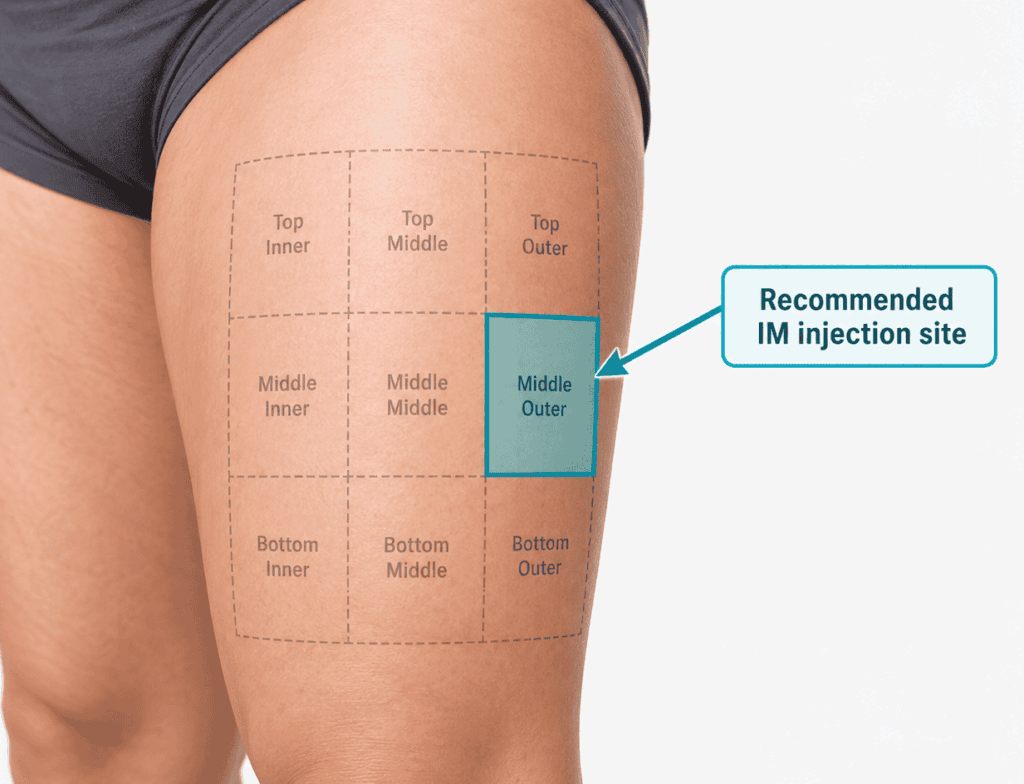
Another option is the gluteal region, particularly the ventrogluteal site around the side of the hip. Planned Parenthood of Greater Texas lists both the thigh and ventrogluteal hip muscle as options for IM hormone injections, although it notes that using the hip may be easier with help from another person.
The ventrogluteal site uses the gluteus medius and minimus muscles and is generally considered a safer gluteal injection location because it has a relatively thick muscle mass and fewer major nerves and blood vessels than the traditional back-of-the-buttock site. It is located using specific landmarks around the greater trochanter and iliac crest.
Some people are instead taught a dorsogluteal injection, which is given in the upper outer portion of the buttock. That site has historically been used for IM medications, but accurate landmarking matters because the sciatic nerve and major blood vessels are nearby. Current sources generally favor the ventrogluteal site when a gluteal injection is used.
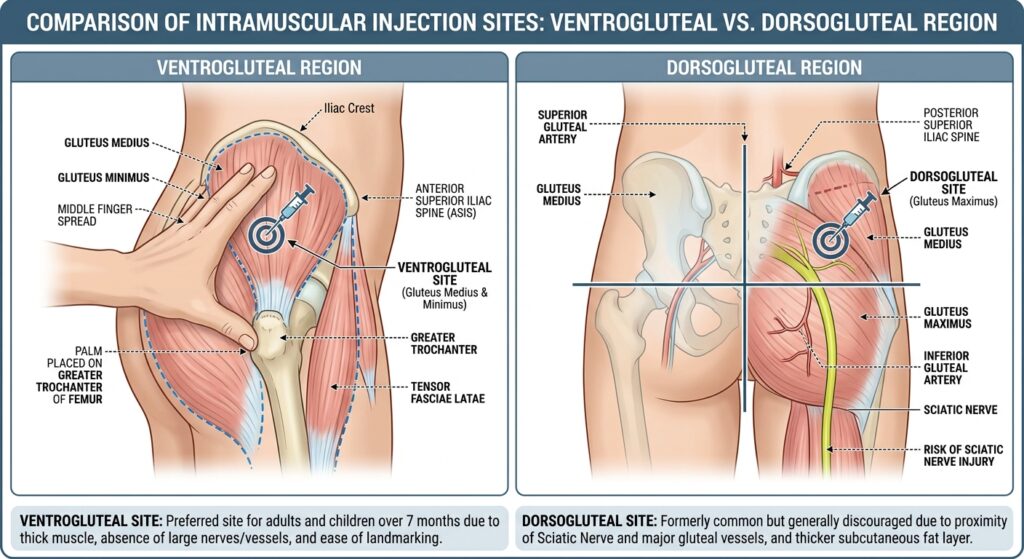
If you currently inject into the gluteal area, the important distinction is which gluteal site you were taught to use. Follow the exact landmarking technique provided by your clinician rather than estimating based on where the buttock appears thickest. Other muscles can also be used for IM medication, but some require more precise landmark identification. Use only locations you’ve been trained to identify safely.
Step 3: Clean the Injection Site
Use a fresh alcohol pad to clean the selected area.
Let the skin air-dry completely. Don’t blow on it or touch the cleaned area afterward.
This gives the alcohol time to work and can also reduce the stinging that sometimes occurs when a needle goes through still-wet alcohol.
Step 4A: Giving a SubQ Testosterone Injection
Gently pinch a fold of fatty tissue at the injection site.
Hold the syringe securely. Depending on your needle, body composition, and the technique your clinician taught you, SubQ injections may be performed at approximately 45 or 90 degrees.
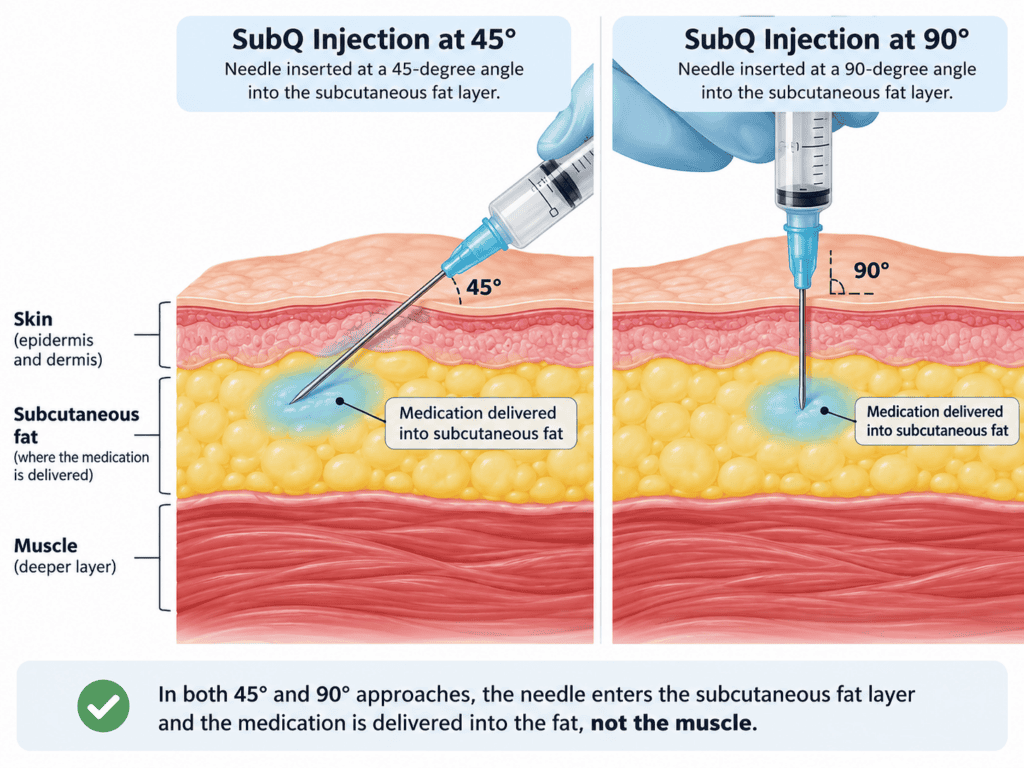
Insert the needle with a smooth, controlled motion.
Slowly depress the plunger until the medication has been delivered.
Wait briefly, then withdraw the needle along the same path it entered.
Release the pinched skin.
Apply gentle pressure with clean gauze if necessary. A small spot of blood afterward can occur and doesn’t automatically indicate that anything went wrong.
Step 4B: Giving an IM Testosterone Injection
Relax the muscle as much as you can. Tensing the thigh can make the injection more uncomfortable.
Hold the syringe at approximately a 90-degree angle to the skin.
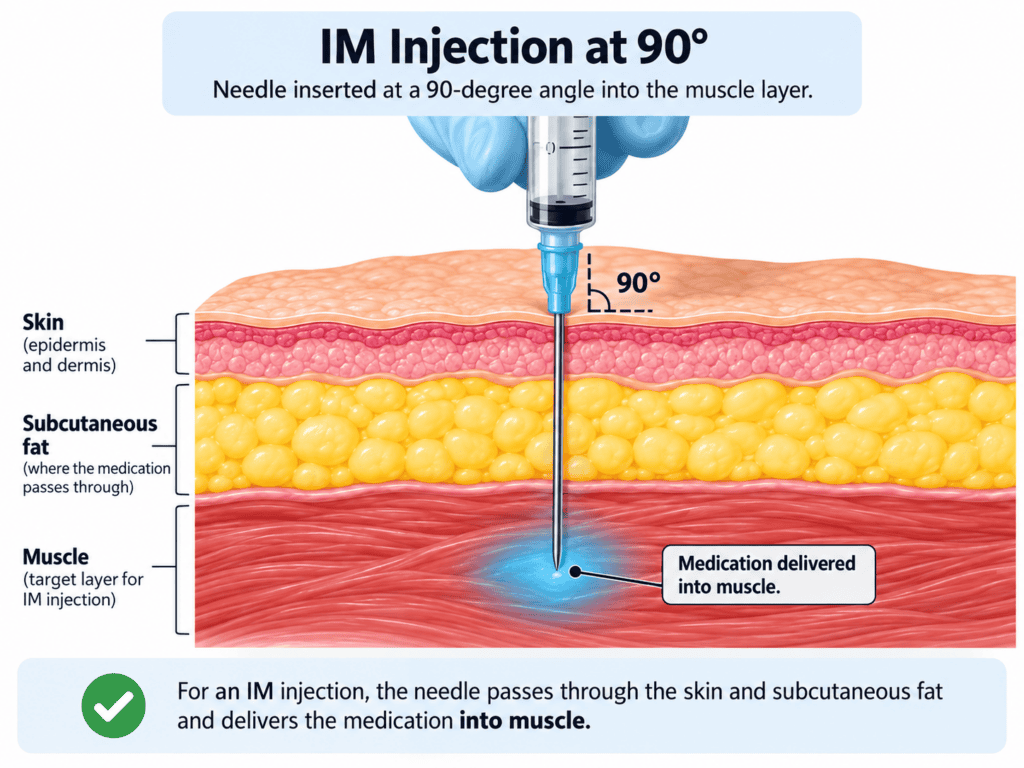
Insert the needle with a controlled, deliberate motion so that it reaches the muscle tissue. Planned Parenthood’s IM self-injection guidance likewise describes the needle entering straight through the skin at 90 degrees.
Slowly depress the plunger and administer the medication.
Withdraw the needle along the same path it entered.
Apply gentle pressure with clean gauze if needed.
Follow your clinician’s instructions regarding any additional technique they specifically taught you.
Do You Need to Aspirate?
This is an area where people often encounter conflicting instructions online.
Rather than following an old YouTube tutorial or advice from someone else’s prescription, follow the technique your current healthcare provider specifically taught you for your injection site and medication. Injection recommendations have changed over time, and procedures used for one kind of injection aren’t automatically appropriate for another.
That’s a good general rule for testosterone injections: don’t add extra steps simply because someone on the internet does them.
After the Injection
Immediately place the used needle and syringe into your sharps container.
Don’t leave loose needles on a countertop, throw them directly into household trash, place them in recycling, or flush them. FDA guidance recommends putting used sharps into the disposal container immediately after use.
If your container becomes roughly three-quarters full, follow your local rules for disposal rather than continuing to pack needles into it. Disposal programs vary by location.
What Can Be Normal After a Testosterone Shot?
Minor injection-site effects can happen with either method. You may occasionally notice mild temporary soreness, a small drop of blood, minor bruising, or tenderness around the injection site.
With SubQ injections in particular, some people occasionally notice a small temporary lump beneath the skin.
Rotating injection sites can help prevent repeatedly irritating the same tissue.
When to Contact a Healthcare Provider
A little soreness is very different from an increasingly painful or infected injection site.
Contact your healthcare provider if you develop worsening redness, significant swelling, increasing warmth, pus or drainage, fever, severe or persistent pain, a significant allergic-type reaction, or an injection-site problem that isn’t improving as expected.
Seek urgent medical care for signs of a severe allergic reaction such as difficulty breathing, significant facial or throat swelling, fainting, or rapidly progressing symptoms.
If you’re simply unsure whether you performed your injection correctly, contacting your clinic or pharmacist is also reasonable. You don’t have to wait until something becomes an emergency to ask a technique question.
What If I Think My SubQ Shot Went Into Muscle or Vice Versa?
This is another source of unnecessary panic.
Planned Parenthood of Michigan notes that injectable testosterone used for gender-affirming care can be administered by either the SubQ or IM route, and accidentally reaching somewhat deeper or shallower tissue does not automatically mean the medication was lost or that another dose should be given.
Do not automatically repeat an injection because you’re uncertain about its depth. That could result in receiving more testosterone than prescribed. Contact your healthcare provider if you’re unsure what happened.
Making Testosterone Shots Less Intimidating
Injection anxiety is common, especially at the beginning.
It can help to prepare everything before uncapping the injection needle, sit somewhere stable, give yourself enough time that you aren’t rushing, deliberately relax the target muscle, and follow the same routine every time.
The first few injections often feel much more complicated than they eventually become. Once drawing the medication, identifying the site, and handling the syringe become familiar, the process typically involves far fewer conscious steps.
Planned Parenthood clinics that provide gender-affirming care commonly offer injection teaching specifically because learning the technique with a trained person can be useful before relying solely on written instructions.
SubQ or IM: Which Should You Choose?
There isn’t a universally superior method.
UCSF notes that SubQ testosterone has been used with good efficacy and patient satisfaction and has potential advantages such as smaller needles and potentially less long-term tissue trauma compared with repeated IM injections.
Some people still prefer IM because it’s the method they learned first, they’re comfortable with it, or it works well with their treatment plan.
The appropriate route is ultimately something to decide with the clinician prescribing your testosterone.
Frequently Asked Questions
Can the same testosterone be injected SubQ or IM?
Some commonly prescribed injectable testosterone formulations are used by either route in gender-affirming care. However, don’t change your prescribed route without checking with your clinician because your prescription, supplies, and instructions were chosen for your treatment plan. UCSF specifically discusses both IM and SubQ administration of injectable testosterone. Transcare
Does SubQ testosterone work as well as IM testosterone?
SubQ testosterone is widely used in gender-affirming care, and UCSF reports good efficacy and patient satisfaction with the route. The important issue is achieving appropriate testosterone levels and clinical response—not making the needle reach the deepest possible tissue. Transcare
Should I use a new needle after drawing testosterone?
If your prescribed setup uses separate drawing and injection needles, replace the drawing needle with a new sterile injection needle as instructed. Never reuse a previously used needle or syringe. CDC
Can I reuse a syringe if I change the needle?
No. Needles and syringes are single-use equipment. CDC injection-safety guidance states that both should be discarded after use. CDC
What if a little testosterone leaks out afterward?
A very small amount of medication or fluid at the injection site can sometimes occur. Don’t automatically inject additional testosterone to compensate. If leakage happens frequently or seems substantial, ask your healthcare provider to review your technique.
Do I have to use the same leg every time?
Injection sites should generally be rotated rather than repeatedly using exactly the same spot. Follow the site-rotation pattern recommended by your clinician.
What if I’m afraid of needles?
Tell your provider. SubQ injections may be easier for some people because they typically use smaller needles, and other testosterone formulations such as gel may avoid self-injection entirely. Transcare
A note from Finding True Masculinity
Learning to inject testosterone can feel strangely significant. You’re handling medication, needles, measurements, and your own body all at once and for some people that first injection carries years of anticipation with it.
It doesn’t have to become a test of toughness.
Being nervous about a needle doesn’t make you less masculine, and needing someone to demonstrate the process more than once doesn’t mean you’re doing transition wrong. Technique is learned. Confidence usually comes with repetition.
The goal isn’t to prove you can tolerate a needle. It’s to take your medication safely, consistently, and in a way that works for you.
Helpful Links
- Planned Parenthood IM and SubQ Injection Training Guide — A broad self-injection guide covering supplies, preparation, site selection, and both injection routes.
- Planned Parenthood IM Guide — Illustrated step-by-step guidance for intramuscular hormone injections, including injection-site selection.
- Planned Parenthood 2-Page IM Guide — A concise printable reference covering the basic steps of an IM hormone injection.
- Planned Parenthood SubQ Guide — Illustrated instructions for preparing and giving a subcutaneous hormone injection.
- UCSF Masculinizing HRT Treatment Guideline — Clinical guidance on masculinizing hormone therapy, including injectable testosterone, monitoring, and treatment considerations.
- FDA Guide to Safe Use of Sharps — Practical information on handling, storing, transporting, and safely disposing of used needles and syringes.
- CDC Safe Injection Practice Guide — Infection-prevention guidance emphasizing sterile, single-use equipment and safe medication handling.
- NIH/NCBI IM Injection Continuing Education Activity — A detailed review of intramuscular injection anatomy, site selection, technique, and safety considerations.
- Planned Parenthood: Getting the Right Dose of T — Syringe-reading and dose-measurement education to help patients accurately draw the volume they were prescribed.