| Title | Emotional / Power Word |
|---|---|
| Mostly Male, Never Exclusively: My Personal Journey to Plerumquemasc | Personal, Journey |
| Mostly Male, Never Exclusively: The Surprising Meaning of Plerumquemasc | Surprising |
| Mostly Male, Never Exclusively: Discover the Meaning of Plerumquemasc | Discover |
| Plerumquemasc: A Powerful New Way to Understand Male Identity |

Photo by Chinmay Singh on Pexels.com
Key Takeaways
- Plerumquemasc describes a predominantly male gender identity with a distinct, small female component that is always present.
- Both components may fluctuate in intensity, but the male component remains predominant and the female component never disappears or becomes predominant.
- The female component is an aspect of gender identity, not simply femininity, appearance, or behavior.
- Plerumquemasc can coexist with identifying as a man, transgender man, transmasculine person, or nonbinary person; it does not prescribe pronouns or transition goals.
- Frank coined the term to describe his own experience and created a pride flag representing the enduring relationship between the two components.
When “Mostly Male” Is More Accurate Than “Exclusively Male”
For most of my life, I’ve understood myself as a man. That understanding has shaped how I navigate the world, how I relate to my body, and how I want others to recognize me. Transitioning didn’t create that understanding; it gave me the opportunity to live more authentically within it.
But there’s a distinction I’ve struggled to articulate, even after finding language that otherwise describes me well.
I’m male. Predominantly, undeniably male. Yet if I’m being precise about my internal experience of gender, exclusively male doesn’t quite tell the whole story.
There’s a small female component that has never entirely disappeared.
I don’t mean that I occasionally enjoy feminine things or that I have interests, behaviors, or personality traits traditionally associated with women. Masculinity and femininity are expressions, and neither determines someone’s gender. A man can be feminine without being any less of a man, just as a woman can be masculine without being any less of a woman.
What I’m describing exists beneath presentation. It’s part of how I experience gender itself.
That female component isn’t equally weighted against my male identity. It doesn’t compete with my manhood or periodically replace it. It remains relatively small, sometimes so minuscule that I barely perceive it, and at other times a little more noticeable. There’s no predictable pattern to its fluctuations, and my male identity can fluctuate in intensity as well. What remains consistent is that my gender is predominantly male.
For a long time, I didn’t have a word that captured that particular relationship.
There are existing identities that describe partial connections to manhood, the experience of multiple genders, and fluctuations in gender intensity. Some come close to describing what I experience. But none of the terms I encountered communicated the combination I wanted to express: a predominantly male identity accompanied by a distinctly female component that is always present, never predominant, and variable in intensity.
I also didn’t want a term that required me to abandon my identification as a man or automatically place myself outside the gender binary. I understand why some people with similar experiences identify as nonbinary, and that may be entirely appropriate for them. But I wanted language that could accommodate different relationships with manhood without dictating how someone must classify themselves.
That’s what led me to coin plerumquemasc.
Derived from the Latin plerumque, meaning “mostly” or “for the most part,” combined with masc, the term describes a predominantly male gender identity that includes a small, persistently present female component. Both components may fluctuate, but the overall identity remains predominantly male.
I didn’t coin plerumquemasc because I believe every variation of human gender requires its own label. Nor do I think anyone needs to dissect their identity into increasingly specific categories to understand themselves or justify their existence to others.
I coined it because sometimes the difference between almost accurate and actually accurate matters.
For me, being a man and acknowledging that small female component are not mutually exclusive experiences. One does not invalidate the other. My gender isn’t a contradiction that needs to be resolved, and it isn’t something I need to simplify for the comfort of people who expect gender to fit neatly into one of two boxes.
I’m mostly male. That has always been the most meaningful part of how I understand myself.
But mostly isn’t the same as exclusively.
And for the first time, I have a word that allows me to acknowledge both without diminishing either.
What Is Plerumquemasc?
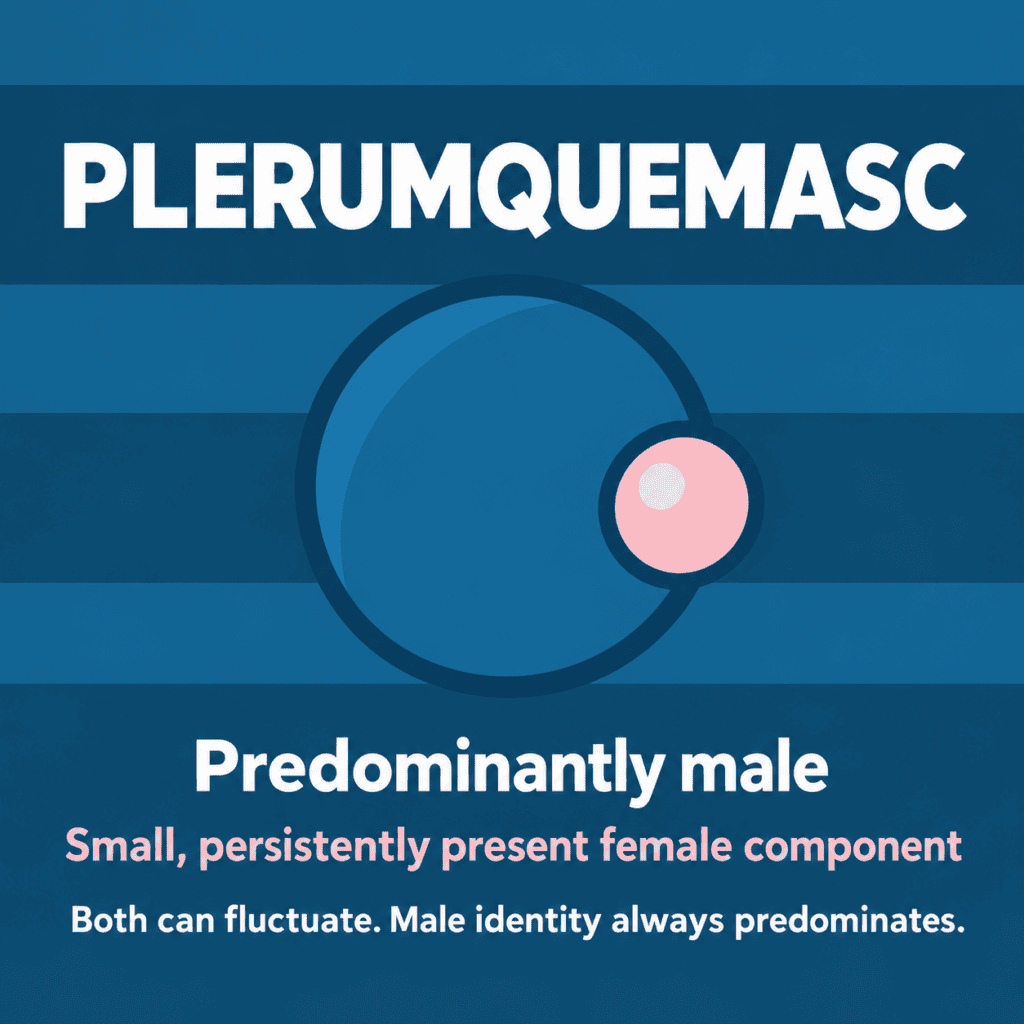
Plerumquemasc is a gender identity characterized by a predominantly male sense of self accompanied by a distinct, persistently present female component. Both components may fluctuate in intensity, but the female component remains relatively small, varying unpredictably between minuscule and small without ever disappearing entirely. Regardless of these fluctuations, the male component always remains predominant.
The term describes a specific relationship between two components of gender: one that is primarily male and another that is explicitly female. It does not describe a person who simply feels masculine most of the time, occasionally enjoys femininity, or moves unpredictably between identifying entirely as a man and entirely as a woman.
The distinction matters because plerumquemasc isn’t defined by alternating between two separate gender identities. Instead, both components coexist, even as their relative intensity changes.
The Defining Characteristics of Plerumquemasc
There are several characteristics that distinguish plerumquemasc from broader terms describing partial or multiple gender identities.
A predominantly male identity
The male component forms the primary foundation of a plerumquemasc person’s gender. Although its intensity may fluctuate, it remains predominant. Someone may experience periods when their connection to maleness feels particularly strong and others when it feels somewhat less pronounced, but the female component never becomes the dominant aspect of their gender.
A distinctly female counterpart
The remaining component is specifically female. It is not an absence of gender, an unidentified gender, a neutral component, or simply a connection to femininity.
This is an essential distinction. Someone can be a masculine man, a feminine man, or a man whose expression changes from day to day without necessarily experiencing a female component within their gender identity.
Plerumquemasc refers to the internal experience of being predominantly male while also possessing a smaller, identifiable female component.
A female component that is always present
Unlike gender experiences in which a particular component may disappear entirely or become temporarily inaccessible, the female aspect of plerumquemasc remains present.
It may become so subtle that the individual barely notices it, but it does not cease to exist.
The presence of that component is not dependent on whether the person is actively thinking about their gender, expressing femininity, or experiencing a particular emotional state. It is simply part of their underlying experience of self.
Fluctuation without a change in predominance
Both the male and female components may fluctuate in intensity. The female component, in particular, can change unpredictably, becoming more or less perceptible without following a recognizable cycle.
These fluctuations do not necessarily occur in opposition to one another. An increase in the female component does not automatically require an equivalent decrease in the male component.
Gender is not a mathematical equation in which every component must occupy a fixed percentage of a whole.
What matters is the relationship between the components: the male component remains predominant, and the female component remains present but comparatively small.
Does Plerumquemasc Require Someone to Identify as Nonbinary?
No. While plerumquemasc describes a gender experience that may overlap with multigender or nonbinary identities, identifying as nonbinary is not a requirement.
Someone may understand himself as a man while recognizing that his internal experience of gender includes a smaller female component. Another person with the same underlying experience may consider themselves nonbinary, multigender, or both.
Neither interpretation is inherently more accurate than the other. The broader identity label someone chooses depends on how they understand and describe their own gender.
Plerumquemasc provides language for the specific experience of gender, rather than prescribing how someone must relate to the gender binary.
For that reason, plerumquemasc can coexist with identifying as a man, transgender man, transmasculine person, or nonbinary individual.
It also does not establish a required set of pronouns. Someone identifying as plerumquemasc may use he/him pronouns, including when they understand themselves as a man or trans man. Others may use different pronouns or combinations of pronouns that reflect their individual preferences.
The presence of a female component does not automatically determine how a person wishes to be addressed or recognized socially.
What Plerumquemasc Does Not Describe
Defining a gender identity also requires explaining what falls outside its intended meaning.
Plerumquemasc is not synonymous with being a feminine man, enjoying traditionally feminine activities, having a particular body type, or maintaining a connection to experiences associated with being assigned female at birth.
It also does not inherently describe uncertainty about being a man.
A plerumquemasc person may be entirely confident in their identification as male while recognizing that maleness is not the only component of their gender.
Likewise, the female component should not be interpreted as an indication that someone is less committed to transitioning, less comfortable being recognized as male, or less authentic in their manhood.
Gender identity, gender expression, physical characteristics, and transition goals are related aspects of a person’s experience, but they are not interchangeable.
Plerumquemasc concerns the first of these: the internal experience of gender.
A Word for an Experience, Not a Set of Rules
I want to be careful about one final distinction.
Although plerumquemasc has defining characteristics, it is not intended to establish arbitrary thresholds for how male or female someone must feel. There is no required percentage, no predetermined frequency of fluctuation, and no expectation that someone must constantly evaluate or quantify their gender.
The terms predominant, minuscule, and small are descriptive rather than mathematical.
They communicate the general relationship between the male and female components without attempting to turn a deeply personal experience into something that can be measured objectively.
For someone whose gender is predominantly male, whose female component is always present but never predominant, and whose experience of both may vary over time, plerumquemasc offers a way to describe that relationship without having to explain it from the beginning every time.
That is ultimately why I coined the term.
Not to establish another rigid category that people must fit themselves into, but to provide language for a particular experience that existing terminology did not fully communicate for me.
Plerumquemasc is not about being insufficiently male. It is about being predominantly male without being exclusively male—and recognizing that the distinction can matter.
The Origin and Etymology of the Term
When I began searching for language to describe my gender more precisely, I wasn’t necessarily looking to create something new. I wanted to find a word that communicated an experience I already understood but couldn’t quite articulate through existing terminology.
I knew I was predominantly male. I also knew that a smaller female component remained part of my gender, regardless of how subtle it became. Existing terms describing partial manhood, multiple genders, and fluctuating gender identities offered useful points of comparison, but I wanted something that captured the particular relationship between those components without requiring a lengthy explanation every time I used it.
That search eventually led me to coin plerumquemasc.
Breaking Down the Word
The term combines two linguistic elements:
Plerumque — A Latin word meaning “mostly,” “usually,” “generally,” or “for the most part.”
Masc — A commonly used abbreviation of “masculine,” particularly within LGBTQ+ and gender-diverse communities.
Together, these elements form plerumquemasc, a term intended to communicate a predominantly male gender identity without implying that maleness is the person’s only gender component.
I chose plerumque because the idea of being “mostly” something felt particularly important. It acknowledges predominance without requiring exclusivity.
That distinction is at the heart of the identity.
A plerumquemasc person isn’t necessarily uncertain about being male, nor are they alternating between entirely male and entirely female identities. Their gender is predominantly male while also containing a distinctly female component that remains present to varying degrees.
The Latin root captures the centrality of the male experience while leaving room for the component that exists alongside it.
Why Not Simply Call It “Mostly Male”?
There is nothing inherently wrong with describing oneself as mostly male. In fact, that is probably the simplest explanation I can offer when introducing plerumquemasc to someone unfamiliar with the term.
But mostly male is a broad description.
It doesn’t necessarily communicate what makes this particular experience distinct. Someone could identify as mostly male because they occasionally experience gender neutrality, because their gender fluctuates between male and another identity, or because they have a partial connection to manhood that they cannot define more specifically.
Plerumquemasc establishes a narrower meaning.
The remaining component is explicitly female. It does not disappear. Its intensity changes unpredictably, but it remains comparatively small, and the male component always predominates.
Those characteristics are what distinguish plerumquemasc from the broader experience of being mostly male.
Having a specific term also allows someone to communicate that relationship without repeatedly explaining the individual components of their gender from scratch.
Why I Chose to Coin a New Term
I’m aware that LGBTQ+ terminology is extensive, and I understand why the introduction of another identity label might seem unnecessary to someone who hasn’t experienced the need for it.
I don’t believe every variation in gender requires a separate word. Nor do I believe someone needs a highly specific identity label to make their experience legitimate.
But language is useful precisely because it allows us to communicate distinctions that matter.
Gender terminology has never been static. As our understanding of gender develops, so does the language we use to describe it. In my earlier article, Top Trans Terms: A Daring Dip Into the Queer Lexicon, I explored some of the vocabulary that helps transgender and gender-diverse people communicate their experiences. Plerumquemasc is my own contribution to that evolving language.
When I describe myself as a man, I’m communicating something true about who I am.
When I describe myself as plerumquemasc, I’m communicating something more specific about how I experience that manhood internally.
Neither description invalidates the other.
For me, coining plerumquemasc wasn’t about distancing myself from being a man or seeking a label that would place me in an entirely different category. It was about acknowledging a component of my gender that had always existed but wasn’t adequately represented by the terminology I was using.
I wanted a word that allowed me to recognize that component without making it the defining feature of my identity.
And I wanted the term to leave room for other people who experience something similar but understand their broader gender identity differently.
A trans man, a cisgender man, or a nonbinary transmasculine person might all recognize aspects of themselves in the definition. Whether they choose to use plerumquemasc alongside their existing identity labels is entirely their decision.
Establishing Plerumquemasc as a Coined Identity
I am introducing plerumquemasc as a term I coined to describe a particular experience of gender. It is not a clinical classification, a diagnosis, or a claim that everyone with a similar experience must adopt the same terminology.
Its purpose is descriptive.
By documenting its definition, linguistic origins, and distinguishing characteristics, I hope to establish a clear foundation for others who may find the term useful. This article serves as the original published explanation of what I intend plerumquemasc to mean.
Whether it eventually becomes part of a broader LGBTQ+ vocabulary will depend on whether other people recognize their experiences in it and choose to use it.
I don’t need everyone to identify with the term for it to have value.
Sometimes, finding the right language for your own experience is enough. And sometimes, putting that language into the world gives someone else a way to understand something about themselves that they’ve never quite been able to explain.
Plerumquemasc began as my attempt to articulate a distinction within my own gender identity. My hope is that it can also become useful language for others who are predominantly, but not exclusively, male.
The Plerumquemasc Pride Flag

When I began developing plerumquemasc as a term, I also wanted to create a visual representation of the experience it describes. Pride flags have long provided LGBTQ+ communities with recognizable symbols of identity, belonging, and shared experience. For a newly coined term, a flag can also help communicate aspects of its meaning that might otherwise require several paragraphs to explain.
The plerumquemasc flag I designed reflects the relationship between the male and female components that define the identity: a predominantly male experience accompanied by a smaller, persistently present female component.
The design intentionally gives the male component the majority of the visual space while preserving a distinct place for the female component.
The Colors and Their Symbolism
The flag features alternating shades of blue, a smaller pink circle, and a white highlight within that circle.
The following symbolism is proposed for the original design.
| Element | Meaning |
|---|---|
| Medium blue background | The predominant male component that forms the foundation of the identity. |
| Two darker blue horizontal stripes | The changing intensity of the male component while its predominance remains consistent. |
| Pink circle | The distinct female component that remains present within the predominantly male identity. |
| White highlight | The female component’s capacity to become minuscule without ever disappearing completely. |
The contrast between the blue background and the pink circle is intentional. The female component occupies considerably less space, reflecting its comparatively small role within the overall gender experience.
However, its presence is unmistakable.
The female component isn’t hidden, blended into the blue, or represented as an absence of maleness. It has its own distinct place within the design.
That distinction is central to plerumquemasc.
Why the Female Component Is Represented by a Circle
I chose to represent the female component as a circle rather than another horizontal stripe.
The circle creates a distinct visual element within the larger blue field, emphasizing that the female component exists alongside the predominantly male identity without replacing or dividing it.
Its smaller size reflects the relatively limited intensity of that component, while its continued presence represents its permanence.
The white highlight adds another layer of meaning. It can represent the periods when the female component becomes almost imperceptible, yet remains an identifiable part of the overall experience.
The circle does not need to occupy an equal amount of space to be meaningful.
In much the same way, the female component of plerumquemasc does not need to become predominant, or even particularly noticeable, to remain a legitimate part of someone’s gender.
A Visual Representation, Not a Mathematical Formula
Although the flag uses different amounts of space to represent the male and female components, those proportions should not be interpreted as literal percentages.
Plerumquemasc doesn’t require someone to experience their gender according to a particular numerical ratio.
The visual imbalance communicates predominance, not measurement.
Similarly, the flag is a static representation of an identity that includes fluctuation. Its fixed colors and shapes symbolize the continuing relationship between the components rather than any single moment in someone’s experience.
The male component remains predominant. The female component remains present. Both may fluctuate in intensity.
The plerumquemasc flag represents the coexistence of those components without requiring either one to be denied, diminished, or understood as contradictory to the other.
For me, that is what makes the design meaningful. It visually communicates the same distinction that led me to coin the term in the first place: being mostly male does not necessarily mean being exclusively male.
And the smaller component deserves recognition, even when it occupies only a small part of the whole.
Understanding the Male and Female Components
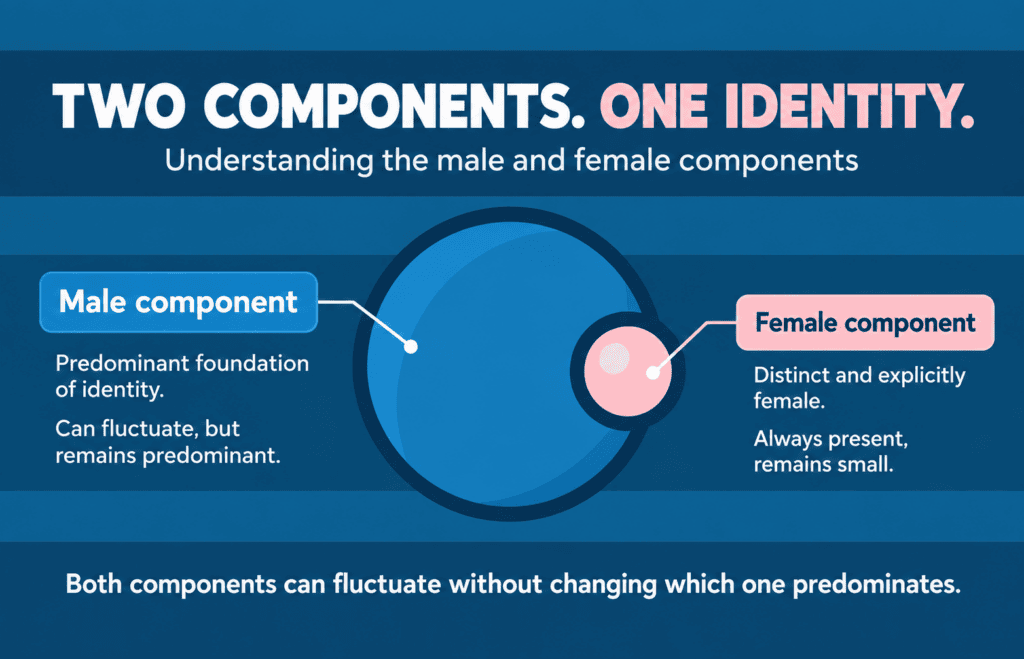
One of the most important aspects of plerumquemasc is the relationship between its male and female components. Understanding that relationship is essential because the identity isn’t simply about experiencing two genders. It’s about experiencing them in a particular way: one remains predominant, while the other is smaller, persistently present, and variable in intensity.
For me, being male is the foundation of my gender identity. It’s how I understand myself, how I navigate the world, and how I want others to recognize me. But that understanding doesn’t erase the smaller female component that exists alongside it.
The two are not mutually exclusive, nor do they need to exist in equal proportions to be meaningful.
The Male Component: The Predominant Sense of Self
In plerumquemasc, the male component is the primary aspect of the individual’s gender identity.
It may fluctuate in intensity, but it remains predominant regardless of what happens with the female component. A plerumquemasc person might experience periods when their sense of being male feels especially pronounced and others when it feels somewhat less intense. These changes do not cause their female component to become dominant or necessarily change how they identify socially.
It’s important to distinguish this internal experience from conventional ideas about masculinity.
A plerumquemasc person does not need to dress masculinely, have traditionally masculine interests, pursue medical transition, or conform to societal expectations of manhood. Their male identity exists independently of those characteristics.
Likewise, the intensity of someone’s male component does not determine whether they deserve to be recognized as a man.
I don’t become more deserving of being called a man when my male component feels particularly strong, and I don’t become less deserving of that recognition when it feels somewhat less pronounced.
My identity isn’t something that needs to be continually proven through appearance, behavior, or the absence of anything associated with womanhood.
For someone who identifies as both a man and plerumquemasc, recognizing the nuances of their internal gender experience doesn’t necessarily change the fundamental way they understand their manhood.
It simply provides a more detailed description of that experience.
The Female Component: Small, Distinct, and Always Present
The female component is what makes plerumquemasc more specific than a general description of being predominantly male.
It is explicitly female.
That distinction matters because gender identity and gender expression are frequently confused, especially when discussing experiences that don’t fit neatly within conventional binary expectations.
I’m not describing a fondness for feminine clothing, traditionally feminine personality traits, or activities that society associates with women. Those things don’t establish someone’s gender, and their presence in a man’s life doesn’t inherently indicate that he experiences any degree of female identity.
I’m describing an internal component of gender that I recognize as female.
It isn’t an absence of maleness. It isn’t gender neutrality. It isn’t an unidentified or ambiguous part of my identity that I’ve decided to label female simply because it doesn’t fit elsewhere.
It is a distinct female component that exists alongside my predominantly male identity.
For a plerumquemasc person, this component remains comparatively small. At times, it may be so minuscule that it barely registers in conscious awareness. At other times, it may become more noticeable.
But it never disappears entirely.
This is an essential part of the definition.
Someone whose female component periodically vanishes completely, or whose gender shifts between exclusively male and exclusively female states, may find other identity terms more accurate. Plerumquemasc specifically describes the enduring coexistence of both components.
The female component doesn’t need to be large, dominant, or constantly noticeable to be a legitimate part of someone’s gender.
Its presence matters because the person experiencing it recognizes it as part of themselves.
The Components Do Not Have to Compete
When we talk about gender components, it’s easy to imagine a fixed scale in which an increase in one necessarily causes a decrease in the other.
But that isn’t necessarily how plerumquemasc works.
The male and female components may fluctuate independently. A person could experience a stronger sense of maleness while simultaneously becoming more aware of their female component. Alternatively, one component might remain relatively consistent while the other changes.
There is no requirement that these fluctuations follow a predictable pattern or maintain a mathematically fixed relationship.
For example, someone might describe their gender as approximately 95% male and 5% female at one point, then 90% male and 10% female at another. But those numbers are illustrative, not diagnostic. They aren’t a measurement of gender, and they shouldn’t be treated as thresholds someone must meet to identify as plerumquemasc.
Personally, I find it more useful to think of the components in terms of relative prominence rather than percentages.
The male component remains the foundation. The female component is an enduring, smaller aspect of the overall experience. Both can change in intensity without fundamentally altering that relationship.
The presence of one doesn’t invalidate the other.
Why the Female Component’s Permanence Matters
There is a meaningful difference between occasionally experiencing a female gender component and experiencing one that remains present even when it becomes almost imperceptible.
Plerumquemasc describes the latter.
The distinction isn’t about how frequently someone thinks about their female component or whether they consciously recognize it every moment of the day.
Most people don’t spend every waking moment actively evaluating their gender identity. An experience can remain part of someone’s identity without occupying their immediate attention.
Instead, permanence refers to the underlying experience itself.
A plerumquemasc person may go through extended periods when their female component feels exceptionally small. They may have days when they don’t think about it at all. But when they reflect on their gender, they recognize that this component hasn’t ceased to exist.
It’s still there, even when it isn’t prominent.
For me, this distinction helps explain why exclusively male terminology can feel accurate in everyday conversation while still leaving part of my internal experience unacknowledged.
I’m not intermittently becoming female or temporarily losing my connection to being male. I’m experiencing a predominantly male identity that includes a small female component, whether I’m particularly aware of that component at the time or not.
Fluctuation Does Not Necessarily Mean Fluidity
Another important distinction concerns the unpredictable changes in intensity that characterize plerumquemasc.
The female component may become more or less noticeable without following any particular pattern. The male component can fluctuate as well, provided it remains predominant.
Someone might reasonably recognize similarities between this experience and genderflux, a term commonly used to describe fluctuations in the intensity of gender.
Others may also identify as genderfluid, particularly if they understand changes in the relationship between their gender components as a form of fluidity.
But plerumquemasc does not require either additional label.
Its defining characteristic isn’t movement between distinct gender states. It’s the continued coexistence of male and female components within a consistently predominantly male identity.
The fluctuations describe how those components are experienced, not necessarily a change in the person’s broader gender classification.
Someone can experience variation within an identity without feeling that they become a different gender every time that variation occurs.
A Female Component Does Not Make Someone Less of a Man
This is perhaps the most personally significant distinction I want to make.
Recognizing a female component within my gender doesn’t mean I consider myself less of a man than someone who identifies as exclusively male.
It means my internal experience is different.
I’ve spent enough of my life navigating expectations about what a man is supposed to look like, how he is supposed to behave, and what supposedly qualifies someone for recognition as male. I have no interest in creating another set of requirements that would force me—or anyone else—to prove the legitimacy of our identities.
There is no universal amount of male identification that makes someone worthy of being called a man.
Likewise, acknowledging the female component of my gender doesn’t require me to reinterpret my entire identity or abandon the language that has helped me understand myself.
I can identify as a man, recognize that my gender is predominantly male, and acknowledge that a smaller female component remains present.
Those statements can coexist.
For another person, the same combination of experiences might inform their identification as nonbinary, multigender, or transmasculine without an exclusive connection to manhood. That person may find a different relationship between these labels equally meaningful.
Plerumquemasc doesn’t attempt to resolve those differences by prescribing which broader identity someone must adopt.
It simply describes the particular relationship between the male and female components.
The male component remains predominant. The female component remains present. Both may fluctuate, and neither needs to be denied for the person to describe their gender accurately.
For me, that is the value of having a word like plerumquemasc. It allows me to acknowledge the entirety of my gender experience without treating the smaller component as a contradiction, an inconvenience, or something I need to explain away.
Why Permanence and Fluctuation Both Matter
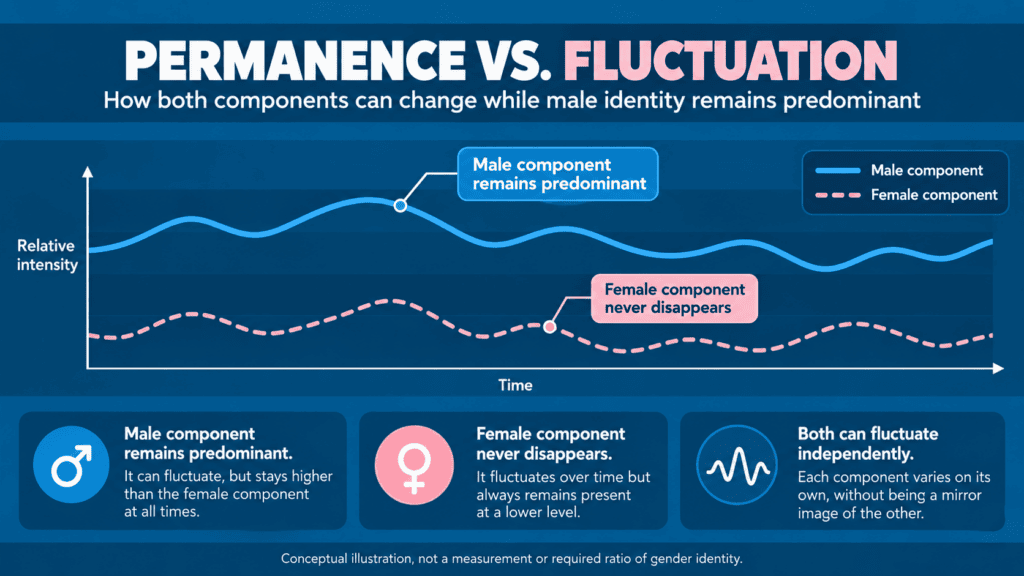
One of the defining characteristics of plerumquemasc is the relationship between permanence and fluctuation. At first, those concepts might seem contradictory. How can something be a permanent part of your identity if its intensity is constantly changing?
The answer lies in understanding that presence and intensity are not the same thing.
Something can remain part of who you are without feeling equally prominent at every moment. Our awareness of different aspects of ourselves changes throughout our lives, sometimes in response to circumstances and sometimes for reasons we can’t identify. Gender can be experienced with similar variation.
For someone who identifies as plerumquemasc, the male and female components coexist continuously, even as their respective intensities fluctuate. The female component remains relatively small, but its presence is not temporary. The male component may also change in intensity, but it remains predominant.
Neither component has to remain at a fixed level for the overall identity to remain consistent.
This relationship is essential to understanding why I consider plerumquemasc a distinct experience rather than simply another way of describing occasional femininity, alternating genders, or uncertainty about being male.
Permanence: The Female Component Never Completely Disappears
For me, the permanence of the female component is one of the most important aspects of the identity.
There are times when that component feels so minuscule that I hardly notice it. My experience of being male is so predominant that describing myself simply as a man feels entirely natural, and I have no particular reason to think about the smaller female aspect of my gender.
But when I reflect on my identity more closely, I recognize that the female component hasn’t disappeared. It has simply become less perceptible.
At other times, it becomes somewhat more noticeable. It never overtakes my male identity, but its presence is easier to recognize.
The distinction is subtle, but it matters.
I don’t experience myself as exclusively male during one period and partially female during another. Rather, I experience a persistent combination of male and female components in which the relative prominence of each can change.
The female component is part of the underlying structure of my gender, not something that periodically enters and exits it.
That doesn’t mean I consciously experience it every second of every day. There is a difference between not actively perceiving something and understanding that it is no longer present.
I don’t constantly think about being a man, either. My gender doesn’t cease to exist whenever I’m occupied with work, spending time with loved ones, or dealing with the ordinary responsibilities of life.
Likewise, the fact that my female component isn’t always at the forefront of my awareness doesn’t mean it has temporarily vanished.
In plerumquemasc, permanence describes the continued presence of the component, not the frequency with which someone thinks about it.
Fluctuation: Gender Doesn’t Have to Remain at a Fixed Intensity
While the female component is permanently present, its intensity is not fixed.
It may become more noticeable without warning, then gradually or suddenly recede to a nearly imperceptible level. These changes don’t necessarily follow a cycle, correspond to particular events, or reflect an identifiable emotional state.
For me, that unpredictability is part of the experience.
I can’t necessarily explain why the female component feels more pronounced at one moment than another. I don’t always recognize a trigger, and I don’t need to identify one for the experience to be valid.
It’s simply how that component of my gender behaves.
The male component can fluctuate as well. There may be periods when my sense of maleness feels especially prominent and others when its intensity is somewhat different.
But the underlying relationship remains consistent: my gender is predominantly male.
That is an important distinction because plerumquemasc does not require the male component to remain completely unchanged while the female component fluctuates around it.
Both can vary.
What remains stable is the predominance of the male component and the continued presence of the smaller female component.
Fluctuation Is Not Necessarily a Trade-Off
When people imagine two components fluctuating within an identity, they may picture a scale with one side rising whenever the other falls.
But I don’t think that adequately captures the experience I’m describing.
The male and female components don’t necessarily operate in direct opposition. An increase in the female component doesn’t automatically mean the male component has decreased by an equivalent amount.
It’s possible for both to feel more pronounced at the same time, or for one to change while the other remains relatively consistent.
This is why I would avoid defining plerumquemasc through numerical percentages.
Someone might find percentages helpful when describing their gender informally, but there is no meaningful way to establish that a person must be exactly 90% male and 10% female, for example, to qualify for the identity.
The terms predominant, minuscule, and small communicate the relationship more effectively.
They allow the individual to describe relative intensity without being expected to measure something that is fundamentally subjective.
Plerumquemasc isn’t defined by a mathematical ratio. It’s defined by an enduring pattern of gender experience.
Why Unpredictability Is Part of the Experience
Another important characteristic of plerumquemasc is that the female component does not have to fluctuate according to a recognizable pattern.
There may be no predictable interval between changes, no consistent circumstances that make the component more noticeable, and no reliable way to anticipate how pronounced it will feel tomorrow.
For some people, changes in gender experience are connected to particular situations, emotions, relationships, or stages of life. Others recognize recurring patterns over time.
Plerumquemasc doesn’t require either experience.
Its defining characteristics are the persistence of the female component, its comparatively small intensity, and the continued predominance of the male component—not the existence of an identifiable explanation for every fluctuation.
Personally, I think this matters because people are often expected to explain their gender experiences in ways that make sense to someone else.
Why do you feel more male today? What changed? Did something happen? Does the female component appear when you’re emotional? Is it related to your past?
Those questions may come from genuine curiosity, but they can also reflect an assumption that every variation in gender must have an identifiable cause.
Sometimes, the most accurate answer is simply that the experience changes.
I don’t believe I need to establish a psychological explanation for every fluctuation in order to describe it accurately.
Does Fluctuation Make Plerumquemasc a Fluid Identity?
This is where the relationship between plerumquemasc and existing gender terminology becomes particularly interesting.
Terms such as genderfluid and genderflux describe experiences involving changes in gender or its intensity. Someone who identifies as plerumquemasc may recognize similarities between their experience and either of those identities.
But I don’t want to make an additional identity label a requirement of plerumquemasc.
There is a distinction between experiencing changes within an identity and understanding oneself as moving between different gender identities.
In plerumquemasc, the male and female components remain present throughout the fluctuations. The overall experience remains predominantly male, even when the relative intensity of either component changes.
Someone may interpret those changes as a form of genderflux or genderfluidity. Another person may understand them simply as variations within a consistent gender identity.
Both interpretations can coexist with the definition of plerumquemasc.
The term describes the underlying relationship between the components without dictating how someone must categorize that relationship within the broader language of gender diversity.
Why Both Characteristics Are Essential to the Definition
If I removed permanence from the definition, plerumquemasc could describe someone whose female component occasionally appears but completely disappears at other times.
That isn’t the experience I intended to name.
If I removed fluctuation, the term could describe someone whose male and female components remain at fixed intensities throughout their life.
That wouldn’t adequately capture the experience I intended, either.
And if I removed the requirement that the male component remain predominant, the definition would lose the relationship that distinguishes plerumquemasc from other identities involving male and female components.
Each characteristic contributes something essential.
Permanence establishes that the female component is an enduring part of the person’s gender.
Fluctuation establishes that the intensity of the components can change.
Predominance establishes that the male component remains the primary aspect of the identity throughout those changes.
Taken together, they describe an experience that is both consistent and variable.
That might sound paradoxical until we recognize that consistency doesn’t require an absence of change.
A person’s identity can have enduring characteristics while the way they experience those characteristics evolves or fluctuates.
I Don’t Become a Different Person Every Time the Intensity Changes
Perhaps the most important point I want to make is that these fluctuations don’t leave me questioning who I am every time they occur.
When the female component becomes more noticeable, I don’t suddenly stop being a man. When it becomes almost imperceptible, I don’t consider myself to have temporarily become exclusively male.
I remain myself.
My relationship with the individual components of my gender may change in intensity, but I don’t experience those changes as invalidating the identity I’ve established.
And I don’t believe someone needs to repeatedly reassess or rename their entire gender every time they notice a fluctuation.
For me, plerumquemasc provides a consistent way to describe an experience that includes change.
It acknowledges that my male identity remains predominant without pretending that the female component disappears whenever it becomes less noticeable.
It also acknowledges that the female component can become more pronounced without suggesting that my manhood has somehow been diminished or replaced.
Permanence explains what remains. Fluctuation explains what changes. Plerumquemasc describes the relationship between the two.
That relationship is precisely what I wanted to capture when I coined the term.
I didn’t need language that forced my gender into a fixed, unchanging arrangement. I needed language that could accommodate the way I actually experience it: predominantly male, persistently accompanied by a smaller female component, and capable of variation without becoming something entirely different.
Plerumquemasc vs. Paraboy, Demiboy, Bigender, Genderflux, and Genderfluid
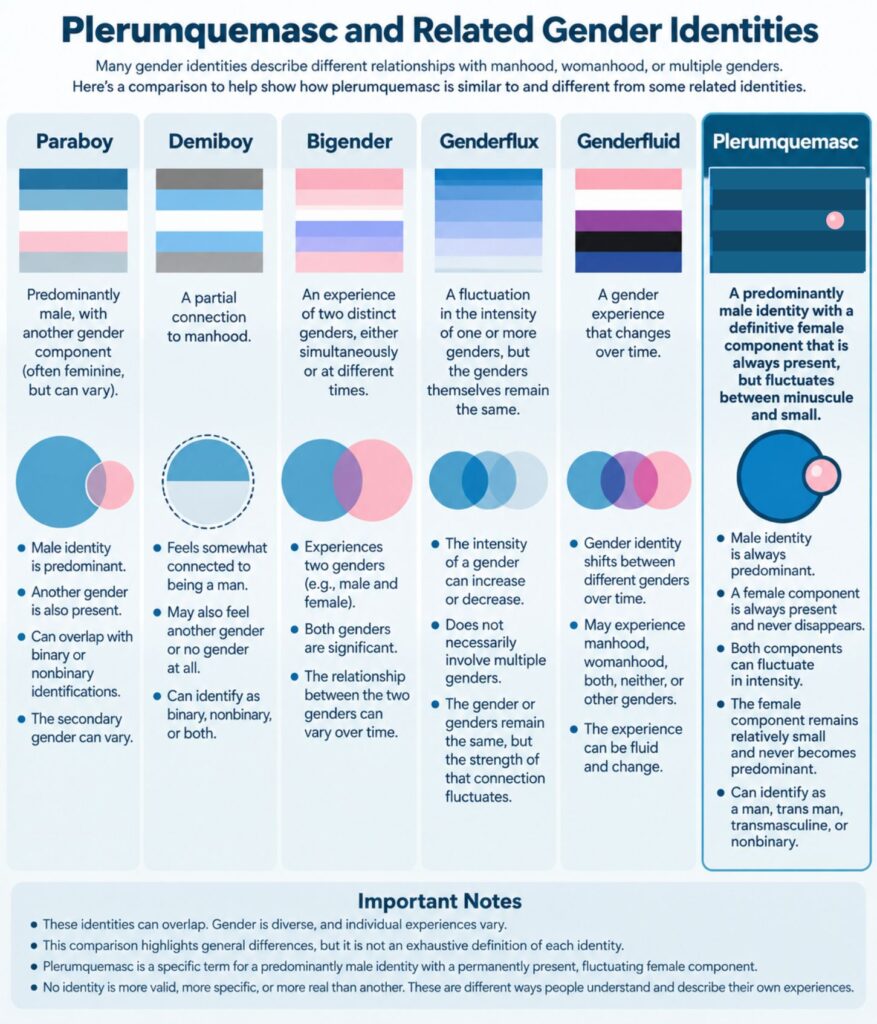
When I began developing plerumquemasc, I knew I wasn’t the first person to recognize that gender could involve multiple components, partial connections, or changes in intensity. LGBTQ+ communities have developed extensive vocabularies for experiences that don’t fit neatly into conventional expectations of being exclusively male or exclusively female.
Several existing identities describe experiences that overlap with plerumquemasc. Some are broad enough that a plerumquemasc person might reasonably identify with them as well. Others share individual characteristics without describing the complete experience I intended to name.
I think acknowledging those similarities is important.
Coining a new term doesn’t require pretending that every aspect of the experience is unprecedented. The purpose isn’t to replace existing identities or suggest that one description is more legitimate than another. It’s to provide language for a particular combination of characteristics that may not be immediately communicated by a broader label.
For plerumquemasc, those characteristics are the predominance of the male component, the persistent presence of an explicitly female counterpart, and the ability of both components to fluctuate in intensity without the female component ever becoming predominant.
Understanding how that experience relates to other identities can help clarify what plerumquemasc means—and what it doesn’t.
Plerumquemasc vs. Paraboy: Predominantly Male, but With a Specific Female Component
Of the existing identity terms I’ve encountered, paraboy is probably one of the closest to what I intended when coining plerumquemasc.
Paraboy falls under the broader paragender umbrella and describes someone who identifies predominantly as a boy or man without identifying exclusively as one. The remaining portion of their gender may involve another gender or combination of genders.
That description certainly overlaps with plerumquemasc.
Both recognize that someone can experience a predominantly male identity without maleness accounting for the entirety of their gender. Neither requires a person to experience an equal relationship between male and other gender components.
But paraboy is broader than the experience I wanted to name.
A paraboy person’s remaining gender experience might be female, nonbinary, neutral, agender, or another gender entirely. Paraboy alone doesn’t establish the specific nature of that remaining component, whether it is continuously present, or whether its intensity fluctuates.
Plerumquemasc specifies all three.
The smaller component must be explicitly female. It must remain present, even when almost imperceptible. And its intensity must be capable of fluctuating while the male component remains predominant.
That doesn’t mean someone who identifies as paraboy cannot also be plerumquemasc. In fact, someone whose gender fits both definitions might reasonably use both labels.
The difference is the level of specificity.
Paraboy communicates that someone is predominantly male without being exclusively male. Plerumquemasc communicates a particular way that nonexclusive maleness is experienced.
I also want to be clear that I didn’t coin plerumquemasc because I consider paraboy inaccurate or insufficient as a general identity. It simply didn’t communicate every characteristic I wanted to capture.
Sometimes a broader term describes you accurately, but a more specific term helps explain how you experience that identity.
Plerumquemasc vs. Demiboy: Partial Manhood and Predominant Manhood
Demiboy, sometimes called demiman or demimale, generally describes someone who has a partial connection to being a boy or man. The extent of that connection can vary, and the remainder of the person’s gender may be another gender, multiple genders, or an absence of gender.
This creates another area of overlap.
Both demiboy and plerumquemasc allow someone to recognize a male component without requiring their gender to be exclusively male.
However, demiboy does not inherently establish that the male component is predominant.
Someone might identify as demiboy because their connection to manhood is relatively small, substantial but incomplete, or difficult to describe in terms of relative intensity.
Plerumquemasc is more specific about that relationship.
The male component must remain predominant, even if its intensity fluctuates. The remaining component must be female, persistently present, and comparatively small.
Another distinction involves fluctuation.
A demiboy person may experience a relatively consistent partial connection to manhood, although demiboy can also coexist with identities involving fluctuations in gender.
Plerumquemasc explicitly includes variable intensity within its definition.
Someone who identifies as demiboy and experiences a predominantly male identity with a smaller, fluctuating female component might find that plerumquemasc describes an additional dimension of their experience.
But identifying as plerumquemasc doesn’t require someone to adopt the demiboy label.
For me, the distinction also involves how I personally relate to manhood.
I don’t experience myself as someone who is only partially entitled to identify as a man. I identify as a man while recognizing that my internal gender experience contains more than maleness alone.
That distinction matters to me, even if another person with a similar experience might find demiboy a meaningful way to describe themselves.
Plerumquemasc vs. Bigender: Two Genders, but Not Necessarily Equal
Bigender describes someone who experiences two genders. Those genders may be male and female, but they can also involve any other combination of gender identities. A bigender person may experience their genders simultaneously, alternately, or through a combination of patterns, and the genders do not have to be equally prominent.
Because plerumquemasc explicitly involves male and female components, it has a particularly meaningful relationship with bigender.
Someone who identifies as plerumquemasc could reasonably consider themselves bigender as well.
After all, their gender includes two distinct components that coexist.
However, bigender alone doesn’t communicate the specific relationship I intended to establish.
A bigender person might experience their two genders equally. One might be predominant. Their relative intensity might change, or their experience might remain consistent.
They might experience both genders simultaneously or alternate between them.
Plerumquemasc describes a narrower arrangement.
Both the male and female components remain present, the male component always predominates, and the female component fluctuates unpredictably within a comparatively small range.
The distinction is not that bigender requires a 50/50 division. It doesn’t.
The distinction is that bigender identifies the experience of two genders, while plerumquemasc specifies which two components are present and how they relate to one another.
For example, someone who experiences being equally male and female might identify as bigender but would fall outside the definition of plerumquemasc.
Someone who experiences being predominantly male with a small, persistently present female component might identify as both.
I think this is an important example of why identity terms don’t always need to compete with one another.
One term can describe the broader structure of someone’s gender while another communicates a more specific experience within that structure.
Plerumquemasc vs. Genderflux: Fluctuation Within a Predominantly Male Identity
Genderflux is another identity that shares an important characteristic with plerumquemasc.
Genderflux describes an experience in which the intensity of someone’s gender changes over time. A person may experience a stronger or weaker connection to a particular gender without necessarily changing which gender they identify with. Genderflux can involve one gender or multiple gender components that fluctuate in intensity.
LGBTQIA+ Wiki
This is particularly relevant because fluctuation is an essential part of plerumquemasc.
Both the male and female components may vary in intensity. The female component fluctuates unpredictably between minuscule and small, while the male component remains predominant regardless of its own fluctuations.
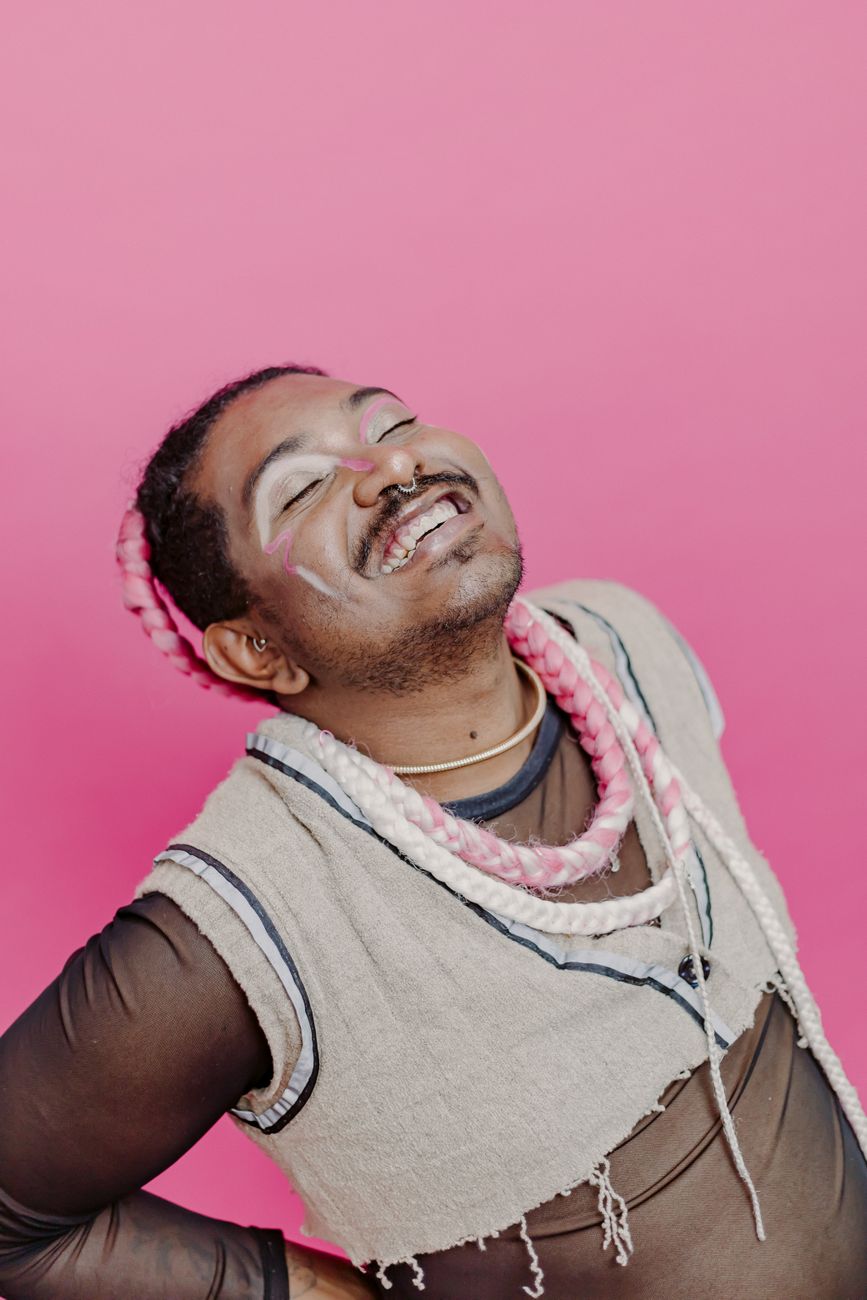
Gender expression and gender identity are not interchangeable. A man’s clothing, mannerisms, or feminine presentation do not determine whether he experiences a female component within his gender. Photo by Christian Araújo on Pexels.com
That experience may fit comfortably within someone’s understanding of genderflux.
But plerumquemasc establishes additional characteristics that genderflux alone does not communicate.
Genderflux doesn’t inherently specify that someone experiences male and female components simultaneously. Nor does it require one component to remain predominant while the other stays continuously present within a relatively small range.
Some genderflux people experience a gender component becoming completely absent at certain times. Others experience fluctuations without ever reaching that point.
Plerumquemasc specifically excludes the complete disappearance of its female component.
For me, this distinction is particularly important.
I’m not describing an experience in which I move between having a female component and having none. I’m describing a component that remains part of my gender, even when its intensity becomes almost imperceptible.
The fluctuations are real, but they occur within an enduring arrangement.
Someone could identify as both genderflux and plerumquemasc if they understand the changes in their male and female components as a form of genderflux.
I simply don’t want plerumquemasc to require that additional label.
It describes the particular gender experience itself, while genderflux may provide another way to describe the nature of its changes.
Plerumquemasc vs. Genderfluid: Fluctuation Does Not Always Mean Alternation
Genderfluid is commonly used to describe a gender identity that changes over time. A genderfluid person’s experience may shift between genders or combinations of genders, and the timing or nature of those changes can vary considerably.
The relationship between genderfluid and plerumquemasc requires a little more explanation because both can involve variation.
However, not all variation in gender needs to be understood as movement between distinct gender identities.
In plerumquemasc, the male and female components remain present throughout the fluctuations. The person does not need to move from being male to being female, from being exclusively male to being partially female, or from having two gender components to having only one.
The underlying arrangement remains consistent.
The male component is predominant. The female component remains present and comparatively small.
What changes is the intensity of those components.
A genderfluid person might experience periods of identifying entirely as male, entirely as female, as both, or as another gender. But that is only one possible pattern of genderfluidity, not a universal requirement.
Someone who identifies as genderfluid could experience changes within a much narrower range.
For this reason, I wouldn’t describe plerumquemasc and genderfluid as mutually exclusive.
A person might understand the fluctuations associated with plerumquemasc as a form of genderfluidity, while another might consider their gender relatively consistent despite those changes.
Both interpretations can be compatible with the term.
Personally, I don’t experience the changes in my gender components as repeatedly becoming a different gender.
I remain predominantly male, and the female component remains part of me.
The fluctuations don’t require me to reconsider my entire identity whenever they occur.
Plerumquemasc gives me language for that continued relationship without requiring me to describe it as movement between separate gender states.
Can Someone Identify With More Than One of These Terms?
Absolutely.
One of the misconceptions surrounding gender terminology is that identities must exist as mutually exclusive categories, with every person expected to select the single term that describes them most accurately.
But different labels can communicate different aspects of the same experience.
Someone might identify as bigender because they experience two genders, genderflux because those genders fluctuate in intensity, and plerumquemasc because their particular experience involves a predominantly male identity with a small, persistently present female component.
Another person might identify as paraboy and plerumquemasc because both describe their relationship with manhood.
Someone else might use only plerumquemasc because they find that it communicates everything they want to convey without additional terminology.
None of these approaches is inherently contradictory.
And I think it’s important to distinguish between an identity’s definition and the additional labels someone chooses to use.
Plerumquemasc has defining characteristics. Those characteristics matter because they give the word a recognizable meaning.
But the term doesn’t need to dictate every other aspect of someone’s identity.
It doesn’t determine whether someone must identify as nonbinary, whether they can call themselves a man, what pronouns they use, or whether they find another gender label meaningful.
Those decisions belong to the individual.
Why I Didn’t Simply Adopt an Existing Term
I could have chosen one of these terms and spent the rest of my life explaining the additional characteristics that made my experience more specific.
There would have been nothing inherently wrong with that.
But language is supposed to help us communicate, and I wanted a word that captured the relationship between my gender components without requiring me to assemble several existing labels every time I attempted to describe it.
Paraboy communicated predominance, but not the specific nature or permanence of the female component.
Demiboy communicated a partial relationship with manhood, but didn’t necessarily reflect my predominantly male experience or the particular characteristics of the remaining component.
Bigender acknowledged the coexistence of two genders, but didn’t establish the relationship between them.
Genderflux described changes in intensity, but not which components were present or their relative predominance.
Genderfluid offered language for gender variation, but didn’t inherently communicate the persistent arrangement I experience.
Each term captured something relevant.
None communicated the entire combination I wanted to name on its own.
That’s why I coined plerumquemasc.
Not because I believe my experience is entirely separate from every existing gender identity, or because I think people who use broader terminology are describing themselves less accurately.
I wanted language that acknowledged all the defining characteristics together.
Plerumquemasc describes a predominantly male identity accompanied by a distinctly female component that is always present, remains comparatively small, and fluctuates unpredictably in intensity. Both components can change, but the male component always predominates.
That definition can overlap with existing identities without becoming interchangeable with them.
And for me, that’s precisely the point.
I didn’t need to establish a completely separate category of human experience. I needed a word that described a particular relationship within an experience that existing language had already helped me begin to understand.
Plerumquemasc, Transmasculinity, and the Gender Binary
One of the reasons I wanted to coin plerumquemasc was to describe my gender more precisely without feeling that I had to abandon the identity I’ve spent so much of my life fighting to have recognized.
I’m a man. I’m a transgender man. Neither statement becomes less accurate because I acknowledge a small, persistently present female component within my gender.
But I also recognize that someone else with a similar internal experience might understand their relationship with manhood differently. They might identify as nonbinary, multigender, transmasculine, or some combination of these identities.
I don’t believe those differences need to be resolved by establishing a single, mandatory classification for everyone who identifies as plerumquemasc.
Instead, I want the term to describe a specific experience of gender while allowing individuals to determine how that experience fits within their broader understanding of themselves.
Plerumquemasc and Transmasculinity
Transmasculine is a broad term commonly used by transgender people assigned female at birth whose gender identity or transition involves movement toward masculinity or maleness. It can include transgender men, nonbinary people, and others whose experiences involve a meaningful connection to masculinity or manhood.
Not every transmasculine person identifies as a man, and not every transgender man uses the term transmasculine to describe himself.
That distinction is important when discussing plerumquemasc.
A transmasculine person might identify as plerumquemasc because the term describes a gender experience in which maleness remains predominant while a smaller female component persists.
For someone who has transitioned socially or medically, this may provide a way to articulate an aspect of gender that isn’t immediately communicated by the word transmasculine alone.
But plerumquemasc doesn’t describe a particular transition pathway.
It doesn’t require testosterone, surgery, a masculine appearance, or a desire to pursue any particular form of gender-affirming care.
It also doesn’t require someone to have been assigned female at birth.
A person’s assigned sex and transition history may influence how they understand their gender, but plerumquemasc is defined by the internal experience of predominantly male identity accompanied by a smaller, persistently present female component.
Transmasculinity and plerumquemasc can describe different aspects of the same person’s experience without being interchangeable terms.
One may communicate a broader relationship with transgender identity and masculinity, while the other describes the particular relationship between male and female gender components.
Can a Transgender Man Identify as Plerumquemasc?
Yes.
And this is a point I want to make explicitly because I know how easily discussions of complex gender experiences can become tangled in assumptions about what transgender men are supposed to feel.
There is a tendency to treat transgender manhood as something that must be demonstrated through complete separation from anything associated with femaleness.
For some trans men, identifying exclusively as male is an accurate description of their experience. Their gender is entirely male, and they have no connection to a female gender component.
That experience deserves to be recognized exactly as they describe it.
But it isn’t necessarily the experience of every transgender man.
For me, acknowledging a female component doesn’t mean that I secretly identify as a woman, regret transitioning, or feel uncertain about being a man.
It certainly doesn’t mean that my transition was an attempt to escape womanhood rather than an effort to live authentically.
My transition and my identification as a man remain meaningful, regardless of the additional nuance I recognize within my gender.
I’ve worked hard to reach a point where I can live as myself. I don’t intend to treat the discovery of more precise language as a reason to question the authenticity of everything that brought me here.
If anything, developing plerumquemasc has allowed me to be more accurate about my experience without feeling that I need to discard the parts of my identity that already fit.
I’m not choosing between being a man and acknowledging a female component.
I’m recognizing that both descriptions can be true within my experience of gender.
Does Plerumquemasc Fall Under the Nonbinary Umbrella?
This is where definitions and personal identification become particularly important.
Nonbinary is commonly used as an umbrella term for gender identities that are not exclusively male or exclusively female. Under that broad definition, plerumquemasc can reasonably be understood as a nonbinary or multigender experience because it includes both male and female components.
But there is a distinction between describing how a gender identity relates to an umbrella category and determining which labels an individual must use.
A person may recognize that their gender experience overlaps with nonbinary terminology without personally identifying as nonbinary.
Another person may find that nonbinary is an important part of how they understand themselves.
Plerumquemasc is intended to accommodate both.
The term does not establish nonbinary identification as a requirement, nor does it prohibit someone from using it.
For example, one person might describe himself as a plerumquemasc transgender man.
Another might describe themselves as a plerumquemasc nonbinary person.
Someone else might identify as bigender, transmasculine, and plerumquemasc simultaneously.
Provided the underlying gender experience fits the definition, those broader classifications can reflect the individual’s own relationship with gender.
I think this distinction matters because identity terminology should help people communicate their experiences, not create additional requirements they must satisfy before being allowed to describe themselves.
The Difference Between Gender Identity and Gender Classification
Something I’ve noticed while exploring gender terminology is that people sometimes approach identity labels as though they function like scientific taxonomic categories.
If an identity contains multiple genders, it must be classified one way. If someone identifies predominantly as male, it must be classified another way. If part of their experience fluctuates, perhaps an additional label becomes mandatory.
That approach can be useful when organizing terminology, but it doesn’t always reflect how people understand themselves.
Gender identity involves both the internal experience of gender and the language someone uses to communicate that experience.
Those two things are related, but they aren’t identical.
Plerumquemasc describes a particular internal relationship: a predominantly male identity accompanied by a small, persistently present female component, with both components capable of fluctuating in intensity.
The broader classification someone chooses may involve additional considerations, including how they understand manhood, their relationship with transgender identity, and whether they find binary or nonbinary terminology meaningful.
I can establish a definition for the term I’ve coined without claiming authority over every other label someone might use alongside it.
That’s an important distinction to me.
I want plerumquemasc to have enough specificity to communicate something meaningful while leaving room for individuals to describe the rest of their identities on their own terms.
Being a Man Doesn’t Require Rejecting Every Connection to Femaleness

Recognizing complexity within our gender doesn’t require us to abandon how we understand ourselves. A plerumquemasc man can acknowledge his female component without diminishing his manhood.
This is probably the most personal aspect of the discussion for me.
Being transgender can involve years of having other people question, scrutinize, or attempt to redefine your gender.
I’ve experienced what it’s like to have my identity treated as something that needs to be explained, defended, or proven.
And I know that, for some transgender men, acknowledging any connection to femaleness can feel particularly vulnerable.
There’s a difference between choosing to recognize a female component within your own gender and having someone else use that component as evidence that you aren’t really a man.
The first is self-understanding.
The second is an attempt to define someone against their will.
I can acknowledge that my gender includes a small female component without inviting other people to reinterpret my identity, change how they address me, or assume that they understand my relationship with manhood better than I do.
I’m not asking anyone to recognize me as partially a woman simply because I have described a female component within my gender.
I’m explaining how I experience gender internally.
Those are not necessarily the same thing.
The language I use to describe the full complexity of my gender doesn’t automatically determine how I want to be recognized in everyday life.
And it certainly doesn’t give someone else permission to disregard my identification as a man.
Plerumquemasc Doesn’t Require Someone to Live Outside the Binary
The gender binary is generally understood as the classification of gender into two categories: male and female, or man and woman.
Nonbinary identities challenge the assumption that everyone fits exclusively within one of those categories.
Plerumquemasc complicates that assumption in a particular way.
It describes an experience that isn’t exclusively male, but it doesn’t require the person to understand themselves as existing outside manhood.
A plerumquemasc person may identify as a man while recognizing a small female component. Another may understand the coexistence of those components as central to their nonbinary identity.
Neither person needs to abandon the term because their relationship with the broader gender binary differs.
I think it’s important to distinguish between someone’s internal gender experience and how they classify themselves socially or personally.
Those distinctions are especially relevant for transgender men who have spent years establishing their identities and may have no desire to adopt an additional nonbinary label.
Someone can use plerumquemasc to describe a specific dimension of their gender without being required to announce a new social identity, alter their pronouns, change their presentation, or reinterpret their transition.
For me, the term adds precision rather than replacing something that already exists.
Making Room for Different Experiences of Manhood
Ultimately, I don’t want plerumquemasc to become another identity that people use to establish rigid boundaries around who can or cannot call themselves a man.
That would contradict much of what led me to coin it.
I know that my experience of gender differs from that of a man who identifies exclusively as male.
I also know that someone who shares my experience of predominantly male identity and a small female component may understand their relationship with manhood differently than I do.
Those differences don’t need to become a competition over whose identity is more accurate or legitimate.
The defining characteristics of plerumquemasc remain consistent: the male component is predominant, the female component is distinctly present and comparatively small, and both may fluctuate without reversing that relationship.
Everything beyond those characteristics deserves room for individual understanding.
Someone may be a plerumquemasc man.
Someone may be a plerumquemasc transgender man.
Someone may be plerumquemasc and nonbinary, bigender, or transmasculine.
And someone may simply use plerumquemasc without feeling that additional terminology is necessary.
For me, being able to say that I’m a man while also having language for the smaller female component of my gender is enough.
I don’t need the term to redefine my manhood. I need it to communicate an aspect of that manhood that previously lacked an accurate description.
Plerumquemasc doesn’t ask someone to choose between acknowledging the complexity of their gender and identifying as a man. It provides language for an experience in which both can coexist.
Pronouns, Gender Expression, and Social Recognition
One of the things I want people to understand about plerumquemasc is that recognizing a female component within my gender doesn’t mean I want that component to dictate how the rest of the world sees me.
I’m a man. I use he/him pronouns. I want to be recognized and addressed as male.
None of that changes because I’ve found a more precise way to describe my internal experience of gender.
I think this distinction matters because people often assume that an identity involving more than one gender must be reflected through multiple sets of pronouns, a particular style of presentation, or some visible combination of traditionally masculine and feminine characteristics.
But an internal experience of gender doesn’t automatically determine how someone chooses to express that gender or how they want others to recognize them socially.
For plerumquemasc individuals, the distinction between identity, expression, and recognition can be particularly important.
Pronouns Don’t Have to Reflect Every Component of Someone’s Gender
Pronouns are one way we communicate how we want to be addressed, but they aren’t a complete description of someone’s internal gender identity.
A person who identifies as plerumquemasc may use he/him pronouns because his gender is predominantly male and he understands himself as a man.
Another person may use he/they, they/them, or another combination that feels appropriate to them.
The presence of a female component doesn’t create an obligation to use she/her pronouns, just as the predominance of the male component doesn’t necessarily prohibit someone from using other pronouns.
Personally, I use male pronouns because they reflect how I understand myself and how I want to be recognized.
I don’t need a different set of pronouns during periods when my female component becomes more noticeable. Those fluctuations don’t cause me to stop identifying as a man, and they don’t change the language I want others to use when referring to me.
Someone else might feel differently, and that’s fine.
I deliberately want plerumquemasc to remain compatible with different pronoun preferences rather than establishing a required set.
Because the identity is predominantly male, I anticipate that he/him pronouns may be common among people who eventually adopt the term. But that is an expectation based on the nature of the identity, not a requirement or an established demographic fact.
The term is newly coined. It would be premature to make claims about how most plerumquemasc people identify or which pronouns they use.
What I can establish is that a plerumquemasc person can use exclusively male pronouns without denying or invalidating the smaller female component of their gender.
Gender Expression Is Not the Same as Gender Identity
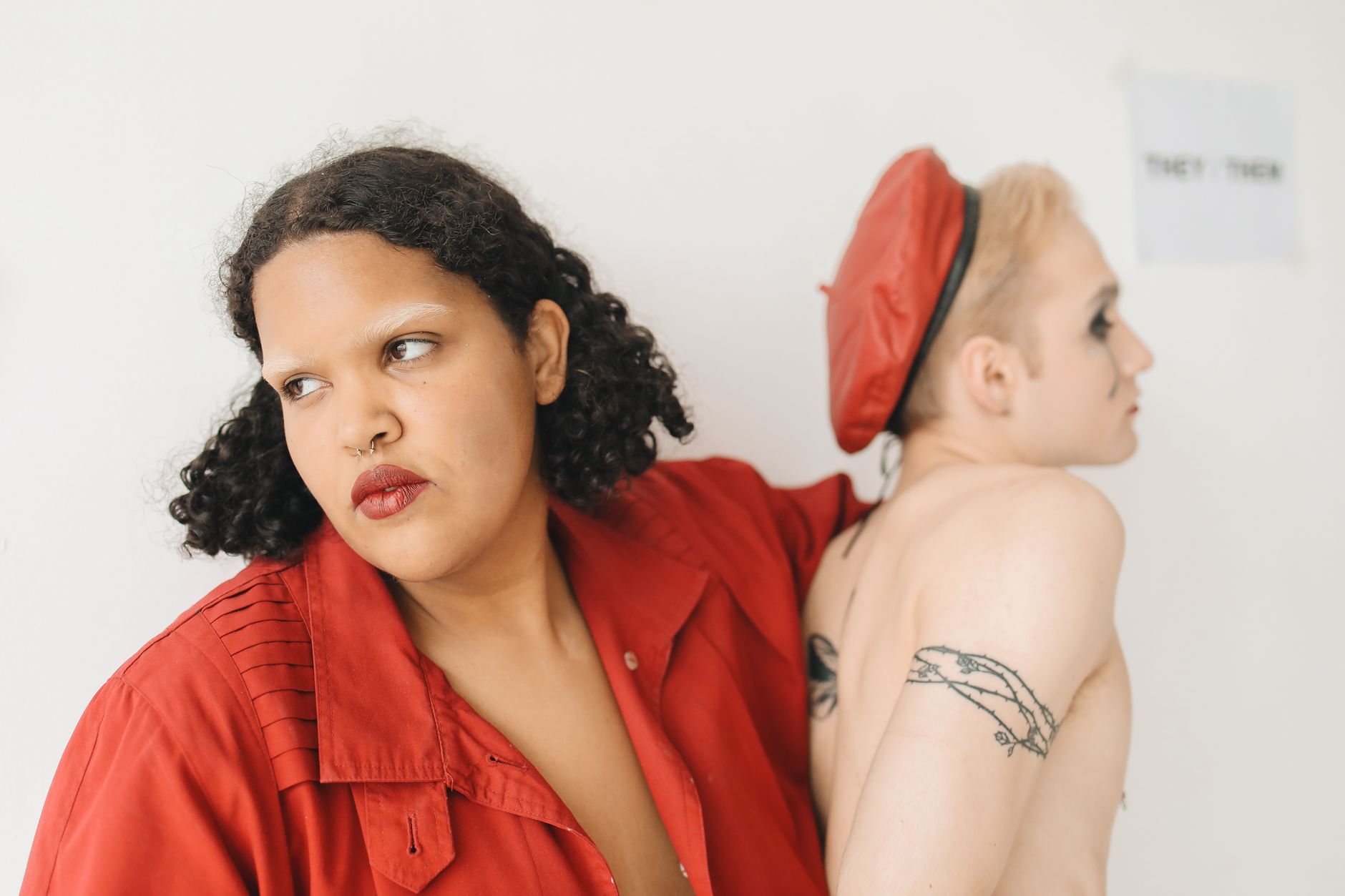
Another distinction worth emphasizing is the difference between experiencing a female gender component and expressing femininity.
Society frequently treats masculinity and femininity as though they are direct indicators of someone’s gender. Men are expected to behave, dress, and present in certain ways, while women are expected to follow a different set of conventions.
But gender expression is not the same as gender identity.
A man who wears makeup doesn’t necessarily experience a female component within his gender. A woman who dresses masculinely doesn’t necessarily experience herself as partially male.
Likewise, a plerumquemasc person doesn’t need to present as a combination of masculine and feminine characteristics to communicate the coexistence of male and female gender components.
Someone might have an entirely masculine presentation and still experience the smaller female component that defines plerumquemasc.
For transgender men and transmasculine people exploring how they want to present themselves, clothing can be a meaningful tool for self-expression and gender affirmation. I’ve explored this in more detail in my guide, How to Dress as a Trans Man: Practical Style Tips for Comfort and Gender Euphoria, which focuses on finding a personal style that feels comfortable and authentic without treating masculinity as a set of rules.
Another person might enjoy a more androgynous appearance or incorporate traditionally feminine elements into their presentation.
Neither approach is inherently more representative of the identity.
For me, the female component isn’t something that necessarily manifests through clothing, mannerisms, interests, or appearance. It exists within my internal understanding of gender, regardless of how I choose to express myself.
And I don’t believe someone should have to visibly demonstrate every component of their gender for those components to be considered legitimate.
Plerumquemasc describes what someone experiences internally, not what another person should expect to see when looking at them.
Social Recognition: Being Seen as a Man
Social recognition is another aspect of gender that doesn’t always communicate the full complexity of someone’s internal experience.
When I interact with the world, I want to be recognized as a man.
I don’t necessarily want every person I encounter to understand the nuances of my gender identity, and I certainly don’t feel obligated to explain those nuances to everyone who knows me.
Being plerumquemasc doesn’t change that.
I can recognize the female component of my gender while still wanting others to use male pronouns, address me as a man, and recognize my identity without qualification.
For some people, the idea of identifying as a man while acknowledging a female component might seem contradictory.
But that assumption depends on treating every gender label as though it must communicate the entirety of someone’s internal experience.
Sometimes a broader label communicates exactly what someone needs it to communicate in a particular situation.
If I introduce myself as a man, I’m not necessarily giving someone an incomplete or misleading description of who I am.
I’m communicating how I identify and how I want to be recognized.
Plerumquemasc provides additional specificity when I choose to discuss the internal experience behind that identification.
I don’t consider those two descriptions to be in competition.
Gender Identity Doesn’t Require Public Disclosure
This is particularly important to me because I’ve had experiences where being open about my transgender identity resulted in treatment I would rather not repeat.
Those experiences have influenced how I navigate disclosure.
Much of my life is lived stealth. I don’t routinely disclose that I’m transgender to people who have no particular reason to know, and I don’t consider that dishonest.
It’s a decision I’ve made about my privacy, safety, and comfort.
Writing publicly about my experiences through FTM Blog is a choice I make on my own terms. It doesn’t mean I’ve decided that every aspect of my identity should become public information in every part of my life.
The same applies to plerumquemasc.
Someone can recognize that the term accurately describes their gender without feeling obligated to explain it to friends, family members, coworkers, romantic partners, or strangers.
They may choose to share it with people they trust. They may use it primarily within LGBTQ+ communities. They may keep it as a private part of their self-understanding.
None of those choices makes the identity more or less authentic.
I also want to distinguish my approach from the experiences of transgender and gender-diverse people who choose to live openly and visibly.
There is nothing inherently wrong with being openly transgender, nonbinary, multigender, or plerumquemasc. Visibility can be meaningful, and public conversations about gender can help people understand experiences they might otherwise never encounter.
But visibility is a personal choice, not an obligation.
Someone’s willingness to disclose their gender history or explain the complexity of their identity shouldn’t determine whether their experience is considered legitimate.
Having language for your identity doesn’t mean you owe that language to everyone else.
The Female Component Does Not Give Others Permission to Misgender Someone
There is another reason I want to make the distinction between internal gender identity and social recognition explicit.
When a transgender man acknowledges any connection to femaleness, some people may interpret that acknowledgment as permission to question his manhood.
A person might assume that the female component means he should accept being called a woman, tolerate feminine pronouns, or reconsider whether he is really male.
That isn’t what plerumquemasc means.
A female component within someone’s gender identity does not automatically establish that they identify as a woman, want to be socially recognized as one, or consent to being addressed using feminine language.
Those are separate matters.
For someone who identifies as a plerumquemasc man, recognizing a small female component can be an act of self-understanding rather than a request for different social treatment.
The distinction is especially important because transgender people are often expected to defend their identities against interpretations imposed by others.
I can describe my gender as predominantly male without inviting someone to decide that the smaller female component is somehow more meaningful than the predominant male one.
I can explain that my female component fluctuates without suggesting that my pronouns or social identity should fluctuate alongside it.
And I can be open about the complexity of my gender without agreeing to have that complexity used against me.
The ability to articulate an identity shouldn’t come at the cost of losing authority over how we describe ourselves.
Does a Plerumquemasc Person Have to Transition?
No.
Plerumquemasc doesn’t establish a required relationship with social, legal, or medical transition.
Someone may identify as plerumquemasc before transitioning, during transition, after years of living as a man, or without pursuing transition at all.
The term also doesn’t establish particular transition goals.
A plerumquemasc person may pursue testosterone, chest surgery, genital surgery, legal name changes, or other forms of gender affirmation. Another person may pursue some of those steps, none of them, or different forms of affirmation entirely.
The presence of a female component doesn’t automatically indicate that someone wants a more feminine body, wishes to retain particular sex characteristics, or feels less strongly about being recognized as male.
Likewise, pursuing medical transition doesn’t erase the female component or make someone less accurately described as plerumquemasc.
The relationship between someone’s gender identity and their transition goals is personal.
I don’t want the definition of plerumquemasc to suggest that there is a particular way someone must transition to demonstrate the predominance of their male identity or acknowledge the persistence of their female component.
Transition is not a measurement of how much maleness someone possesses.
And it certainly isn’t a prerequisite for having a legitimate gender identity.
The Difference Between Being Understood and Being Explained
Ultimately, I think one of the most valuable things about having a specific identity term is that it allows someone to understand themselves without necessarily requiring everyone else to understand every detail.
I coined plerumquemasc because I wanted language that accurately described my experience.
That doesn’t mean I expect every person I meet to become familiar with the term.
Most people who interact with me will simply know me as a man. For everyday purposes, that’s entirely appropriate.
When I choose to discuss my gender more deeply, plerumquemasc provides a way to communicate the relationship between its male and female components.
The two descriptions serve different purposes.
One communicates how I identify and want to be recognized.
The other offers additional insight into how I experience gender internally.
Neither requires me to abandon the other.
And neither creates an obligation to present myself differently, change my pronouns, disclose private information, or make the complexity of my identity visible to satisfy someone else’s expectations.
I can be a man in the world, identify as plerumquemasc within my understanding of myself, and decide when—or whether—I want to explain the relationship between those experiences.
For me, that freedom is part of what makes finding the right language so meaningful.
Why I Coined Plerumquemasc
I didn’t coin plerumquemasc because I was searching for a new identity. I coined it because I was searching for a more accurate way to describe the identity I already have.
There’s a difference.
For years, I’ve understood myself as a man. Transitioning allowed me to bring my life into alignment with that understanding, and I have no desire to diminish the significance of that journey. Being a transgender man is part of who I am, and I’ve worked hard to reach a place where I can live comfortably and authentically as myself.
But self-understanding doesn’t necessarily stop once you’ve found a label that fits.
Sometimes, as you become more comfortable with who you are, you begin recognizing details that previously seemed insignificant, difficult to explain, or simply not worth examining.
For me, one of those details was the small female component that has always existed alongside my predominantly male identity.
It wasn’t something I wanted to eliminate, and it wasn’t something I felt compelled to express outwardly. It was simply there.
I knew it existed. I knew it fluctuated. And I knew that, regardless of how noticeable it became, I remained predominantly male.
What I didn’t have was language that communicated all of those characteristics together.
Finding the Difference Between a Label That Fits and One That Explains
I think there’s a common misconception that finding the right gender label is supposed to be a singular moment of discovery.
You identify the word that describes you, everything falls into place, and the search is over.

Being recognized as a man and having language for the nuances of one’s internal gender experience are not mutually exclusive. Sometimes a more specific identity term helps explain what a broader label doesn’t fully communicate.
For some people, perhaps that’s exactly how it happens.
For others, understanding gender is an ongoing process. Not necessarily because their identity is changing, but because their ability to recognize and articulate it becomes more developed over time.
I don’t consider the discovery of plerumquemasc a departure from my identity as a transgender man.
I see it as a refinement of how I understand that identity.
The word man communicates something important and accurate about me. It describes my primary gender identification and how I want to be recognized.
But when I began examining my internal experience more closely, I realized that the word alone didn’t communicate everything I wanted to express.
There was another component present.
Not an equally weighted second identity. Not a temporary change in gender. Not an absence of maleness.
A small, distinctly female component that persisted even when it became almost imperceptible.
I could describe myself as mostly male, and that would be accurate. But the phrase didn’t explain why I used mostly instead of exclusively.
That distinction was what I wanted to capture.
Why Existing Terminology Didn’t Quite Communicate My Experience
I’m grateful that LGBTQ+ communities have developed language for gender experiences that don’t fit conventional binary expectations.
Without terms such as transmasculine, bigender, demiboy, paraboy, genderfluid, and genderflux, many people would have fewer ways to articulate experiences that society has historically dismissed or misunderstood.
Those terms also gave me a framework for thinking about my own identity.
But as I explored them, I kept encountering the same problem.
Each seemed to describe part of what I experienced without necessarily communicating the entire relationship between my gender components.
Paraboy came close because it describes a predominantly male identity that isn’t exclusively male. But the remaining component doesn’t have to be female, permanently present, or variable in intensity.
Bigender acknowledged the coexistence of two genders, but didn’t establish the particular relationship between them.
Genderflux offered language for changing intensity, but it didn’t inherently communicate that my female component remains present or that my male component always predominates.
I could have adopted several labels and used them together.
But I wanted a term that communicated this specific experience without requiring a lengthy explanation of how each existing identity applied to me.
That desire wasn’t about believing my experience was completely separate from everyone else’s.
It was about recognizing that sometimes a more specific description is useful, even when broader terminology remains accurate.
I Didn’t Want to Erase the Female Component
There is something else I think is important to acknowledge.
As a transgender man, I’ve encountered plenty of expectations about what being a man is supposed to mean.
Some of those expectations come from people who don’t understand transgender identities. Others come from within LGBTQ+ communities themselves.
There can be pressure to demonstrate certainty, consistency, and an absolute separation from anything associated with one’s assigned sex at birth.
For some transgender men, an exclusively male identity is precisely what they experience. They shouldn’t be expected to acknowledge a female component that isn’t there.
But my experience is different.
And I eventually realized that I didn’t need to treat that difference as something I should ignore simply because it might complicate how other people understand my manhood.
I don’t experience the female component as a flaw, a contradiction, or evidence that something about my transition is incomplete.
It’s part of my gender.
A comparatively small part, certainly, but one that has remained present despite fluctuations in its intensity.
I don’t want to erase it merely to make my identity easier for someone else to understand.
I also don’t want to elevate it into something more significant than it actually feels to me.
Both approaches would misrepresent my experience.
Plerumquemasc allows me to acknowledge the female component while preserving the predominance of my male identity.
I don’t have to pretend the smaller component is absent, and I don’t have to treat it as though it defines me more than the male component does.
I wanted language that recognized the female component without allowing it to overshadow my manhood.
I Didn’t Want to Redefine My Manhood, Either
There’s an important distinction between recognizing complexity within your identity and deciding that your existing identity is no longer accurate.
For me, coining plerumquemasc wasn’t an announcement that I had stopped identifying as a man or that I now needed to classify myself differently.
I remain a man.
I remain a transgender man.
I use he/him pronouns, and I want to be recognized as male.
Those things aren’t compromises I’ve made with the predominantly male component of my gender. They’re accurate reflections of how I understand myself.
The fact that I also recognize a female component doesn’t require me to reinterpret everything else.
Someone with a similar experience might identify as nonbinary, and that may be the most accurate description of their gender.
But I wanted plerumquemasc to leave room for people who continue to identify as men, including transgender men, without requiring them to adopt additional terminology that doesn’t resonate with them.
I don’t believe a person should have to choose between accurately describing their internal experience and using the broader gender identity that feels right to them.
For me, both matter.
Why I Chose to Put the Term Into the World
I could have kept plerumquemasc as a private description of my own gender.
There would have been nothing wrong with that.
Not every aspect of our identities needs a public definition, a pride flag, or an article explaining its meaning.
But one of the reasons I created Finding True Masculinity was to make information and experiences accessible to people who might otherwise feel that they’re navigating them alone.
I’ve spent enough of my life searching for answers, resources, and language that I wish had been available to me earlier.
Sometimes that search involves practical information about transitioning, healthcare, or navigating systems that weren’t designed with transgender people in mind.
Other times, it’s something as personal as finding the right words to describe yourself.
I don’t know how many people will recognize their experiences in plerumquemasc.
I don’t know whether the term will eventually become widely used, remain relatively obscure, or primarily serve the people who encounter it through this article.
And I’m comfortable with that uncertainty.
The purpose of coining it isn’t to establish a new category that everyone must acknowledge or to suggest that people with similar experiences should abandon the terminology they already use.
It’s to make another option available.
If someone reads this article and recognizes the relationship between their own male and female components, perhaps plerumquemasc will give them language they didn’t previously have.
If someone reads it and realizes that a different existing term describes them more accurately, that’s useful, too.
And if someone doesn’t identify with the experience at all, perhaps they’ll leave with a better understanding of how another person can experience gender differently without that difference invalidating their identity.
I don’t need everyone to identify with plerumquemasc.
I simply want the term to be available to those who find it meaningful.

Naming Something That Was Already There
Ultimately, plerumquemasc didn’t create a new part of my identity.
It gave me language for something I already recognized.
I was predominantly male before I coined the word. The female component was present before I began trying to describe it. Both could fluctuate before I understood that their particular relationship was something I wanted to put into words.
The name didn’t change those experiences.
It changed my ability to communicate them.
And I think that’s one of the most valuable things language can do.
We don’t always need a label to make something real. Our experiences exist whether or not we’ve found the words to explain them.
But finding those words can make a difference in how we understand ourselves, how we communicate with others, and how we recognize experiences that might otherwise remain difficult to articulate.
I coined plerumquemasc because mostly male was accurate, but it wasn’t quite specific enough.
Because the female component of my gender deserved acknowledgment without becoming the defining feature of my identity.
Because I wanted to recognize the fluctuating nature of both components without suggesting that I periodically become a different person.
And because being a man has never required me to pretend that every aspect of my internal gender experience fits perfectly into someone else’s expectations.
I’m a man. I’m a transgender man. I’m plerumquemasc.
Those statements don’t compete with one another.
They describe different dimensions of the same person.
And after spending so much of my life working toward the freedom to understand and live as myself, I value being able to describe that self as accurately as I can.
Frequently Asked Questions About Plerumquemasc
Because plerumquemasc is a newly coined gender identity, I expect people will have questions about what it means, who can identify with it, and how it relates to more familiar gender terminology.
Some of those questions concern the definition itself. Others involve the assumptions people make about masculinity, manhood, transgender identity, and the relationship between male and female gender experiences.
I’ve gathered the questions I think are most important to address, both for people who recognize themselves in the term and for those who simply want to understand it.
1. What does plerumquemasc mean?
Plerumquemasc is a gender identity characterized by a predominantly male sense of self accompanied by a distinct, persistently present female component.
Both components may fluctuate in intensity, but the male component always remains predominant. The female component varies unpredictably between minuscule and small, never becoming predominant or disappearing entirely.
The term comes from the Latin plerumque, meaning “mostly” or “for the most part,” combined with masc, an abbreviation commonly associated with masculinity.
In simpler terms, plerumquemasc describes someone who is mostly male but not exclusively male, with a small female component that remains part of their gender regardless of how noticeable it becomes.
2. Is plerumquemasc a nonbinary identity?
Plerumquemasc can overlap with nonbinary and multigender identities, but identifying as nonbinary is not a requirement.
Because the identity includes both male and female components, it may fit within broader definitions of nonbinary gender. However, some individuals who experience this relationship may identify as men and consider that description accurate despite the presence of a smaller female component.
Others may identify as nonbinary, bigender, or transmasculine.
I coined plerumquemasc to describe a particular internal experience of gender, not to dictate which broader identity category someone must adopt.
3. Can a transgender man identify as plerumquemasc?
Absolutely.
A transgender man may identify as plerumquemasc if his gender is predominantly male and includes the persistently present, fluctuating female component described by the term.
Recognizing that component doesn’t necessarily change his identification as a man, his pronouns, his transition goals, or how he wants to be recognized socially.
I identify as both a transgender man and plerumquemasc.
For me, those terms communicate different aspects of my identity rather than competing descriptions.
Being plerumquemasc doesn’t make someone less of a man, nor does it suggest that his transgender identity is uncertain or incomplete.
4. Can someone assigned male at birth identify as plerumquemasc?
Yes.
Plerumquemasc is defined by a person’s internal experience of gender, not their assigned sex at birth.
Someone assigned male at birth may experience a predominantly male identity accompanied by a small, persistently present female component.
If that experience aligns with the definition, plerumquemasc may be an appropriate term for them.
The identity does not require someone to be transgender, pursue transition, or have a particular relationship with their body.
5. Is plerumquemasc the same as demiboy or paraboy?
No, although the identities can overlap.
Demiboy generally describes a partial connection to being a boy or man. Paraboy describes a predominantly male identity that is not exclusively male.
Plerumquemasc establishes additional characteristics.
The remaining component must be explicitly female, must remain present, and must fluctuate in intensity while the male component remains predominant.
A person could identify as paraboy or demiboy alongside plerumquemasc if those terms also describe their experience.
The identities aren’t mutually exclusive, but they don’t communicate precisely the same information.
6. Is plerumquemasc a form of bigender?
It can be understood as a specific experience within the broader bigender umbrella.
Bigender describes someone who experiences two genders, which may be male and female or another combination.
Plerumquemasc specifically involves male and female components that coexist continuously, with the male component remaining predominant and the female component comparatively small.
Someone may identify as both bigender and plerumquemasc.
However, bigender identification is not a requirement for using the term.
7. Is plerumquemasc the same as genderfluid or genderflux?
Not necessarily.
Genderfluid generally describes changes in gender identity over time, while genderflux describes changes in the intensity of gender.
Plerumquemasc includes fluctuating gender components, so someone may find that genderflux or genderfluid also describes their experience.
However, the term does not require someone to move between distinct gender identities or adopt either additional label.
In plerumquemasc, both the male and female components remain present throughout the fluctuations. The overall identity remains predominantly male.
8. Does the female component ever completely disappear?
No.
This is one of the defining characteristics of plerumquemasc.
The female component may become extremely subtle, sometimes to the point that the individual barely perceives it, but it never disappears entirely.
There is a difference between not consciously noticing a component of gender and experiencing that component as completely absent.
Plerumquemasc describes the former possibility, not the latter.
Someone whose female component periodically disappears altogether may find another gender identity term more accurate.
9. Can the female component ever become predominant?
No.
The female component can fluctuate between minuscule and small, but it never overtakes the male component.
The male component remains predominant throughout the person’s experience of plerumquemasc.
If someone experiences periods when their female identity becomes equal to or more prominent than their male identity, another term may better describe that broader pattern.
This doesn’t mean those experiences are less legitimate. They simply differ from the specific relationship I intended to name.
10. Can the male component fluctuate too?
Yes.
Plerumquemasc doesn’t require the male component to remain at a fixed intensity.
Both components may fluctuate, provided the male component remains predominant and the female component remains present but comparatively small.
An increase in the female component doesn’t necessarily require a corresponding decrease in the male component.
Gender doesn’t need to operate according to a fixed mathematical ratio.
11. Does the female component fluctuate according to a particular pattern?
No recognizable pattern is required.
The female component may fluctuate unpredictably, becoming more or less noticeable without an identifiable cycle or trigger.
Someone doesn’t need to establish why those changes occur or anticipate when they will happen.
The important characteristics are that the female component remains present, stays comparatively small, and varies in intensity without becoming predominant.
12. Does plerumquemasc mean being masculine and feminine at the same time?
No. This is an important distinction.
Plerumquemasc describes male and female components of gender identity, not masculine and feminine gender expression.
A man can enjoy feminine clothing, interests, or behaviors without experiencing a female component within his gender.
Likewise, someone who identifies as plerumquemasc may present entirely masculinely without feeling any need to express femininity.
The identity concerns how someone experiences their gender internally, not how they look, behave, or conform to social expectations.
13. Are there specific pronouns associated with plerumquemasc?
No particular pronouns are required.
A plerumquemasc person may use he/him, he/they, they/them, or another pronoun set that reflects their preferences.
Because the identity is predominantly male, I anticipate that he/him may be a common choice among people who adopt the term, particularly those who also identify as men or transgender men.
However, plerumquemasc is newly coined, so there isn’t an established community-wide pronoun preference to document.
The female component does not create an obligation to use she/her pronouns.
Personally, I use he/him pronouns and identify as a man.
14. Does identifying as plerumquemasc mean someone is questioning their gender?
No.
Someone can be entirely confident in their gender identity while recognizing that it includes multiple components or fluctuates in intensity.
Plerumquemasc doesn’t describe uncertainty about being male.
It describes a predominantly male identity accompanied by a smaller, persistently present female component.
A person may discover the term while questioning their gender, but questioning is not a defining characteristic of the identity.
15. Does someone have to transition to identify as plerumquemasc?
No.
Plerumquemasc doesn’t require social, legal, or medical transition.
Someone may identify as plerumquemasc before transitioning, during transition, after transitioning, or without pursuing transition.
The identity does not establish particular expectations regarding testosterone, surgery, legal documents, appearance, or any other aspect of gender affirmation.
Likewise, the female component doesn’t automatically indicate that someone wants to retain particular physical characteristics or pursue a less traditionally masculine transition.
Transition goals are individual and cannot be determined from this label alone.
16. Does the female component mean a plerumquemasc person identifies as a woman?
Not necessarily.
Experiencing a female component within one’s gender identity does not automatically establish that someone identifies socially or personally as a woman.
A plerumquemasc person may identify as a man while recognizing the smaller female component as part of his internal gender experience.
Another individual may understand that component as part of a broader multigender or nonbinary identity.
Plerumquemasc describes the relationship between the gender components without requiring someone to adopt womanhood as an additional identity label.
Someone’s own description of their gender should determine how they are recognized and addressed.
17. Can someone identify as plerumquemasc and still live stealth?
Yes.
A person’s internal gender identity doesn’t create an obligation to disclose their transgender history or explain the nuances of their gender to others.
Someone may identify as a plerumquemasc man while choosing to live socially as a man without routinely discussing the smaller female component of his gender.
Others may choose to be open about their identity.
Neither approach is inherently more authentic.
For me, plerumquemasc provides language for understanding and describing my gender, but it doesn’t change my right to decide who receives that information.
18. Does someone need to experience a specific percentage of maleness or femaleness to qualify?
No.
Plerumquemasc isn’t defined by numerical thresholds.
Someone may find percentages useful when informally explaining the relationship between their gender components, but there is no required ratio.
The defining relationship is qualitative: the male component remains predominant, while the female component stays persistently present and comparatively small.
Gender identity isn’t something that can be objectively measured through a percentage-based assessment.
The term describes a recognizable experience, not a mathematical formula.
19. Can someone use plerumquemasc alongside other identity labels?
Yes.
Someone may identify as plerumquemasc and also use terms such as transgender man, transmasculine, paraboy, bigender, genderflux, or nonbinary if those labels accurately describe other aspects of their experience.
Plerumquemasc does not require exclusivity.
Different identity terms can communicate different dimensions of the same person’s gender.
The important consideration is whether the individual recognizes their experience in the definition and finds the term meaningful.
20. Who coined plerumquemasc, and why?
I coined plerumquemasc to describe my own experience of being predominantly male while recognizing a small, persistently present female component that fluctuates unpredictably in intensity.
Although existing gender terminology helped me understand parts of that experience, I wanted a word that communicated the specific relationship between the components without requiring several additional labels or explanations.
The term combines the Latin plerumque, meaning “mostly” or “for the most part,” with masc.
I introduced it through Finding True Masculinity (FTM Blog) to document the experience, establish its intended definition, and make the language available to others who may recognize themselves in it.
I don’t expect everyone with a similar experience to adopt the term, and I don’t believe someone needs a highly specific identity label to validate their gender.
But if plerumquemasc helps another person articulate something they’ve struggled to describe, then sharing it has accomplished what I hoped it would.
The purpose of plerumquemasc is not to tell people who they must be. It’s to offer language for a particular way of experiencing who they already are.
Final Thoughts: Having Language for an Experience That Already Exists
When I began exploring my gender more deeply, I wasn’t expecting to coin a new identity. I wasn’t looking for another label to add to my life, and I certainly wasn’t trying to make something already complicated even more difficult to explain.
I wanted to understand myself.
More specifically, I wanted to understand why describing myself as a man felt accurate, while describing myself as exclusively male left something unacknowledged.
That distinction might seem insignificant to someone who has never experienced it. After all, if the male component of my gender is predominant, why should the smaller female component matter?
For me, the answer is simple: because it’s there.
Its comparatively small size doesn’t make it imaginary. Its fluctuations don’t make it meaningless. And acknowledging its presence doesn’t diminish the male identity that remains central to who I am.
I spent enough of my life trying to make sense of my identity through the expectations and language available to me. I don’t see any reason to disregard a part of my experience simply because it doesn’t fit neatly into someone else’s understanding of what being a man should mean.
Finding Language Doesn’t Mean Finding Something Wrong
I think discussions about gender sometimes become so focused on definitions and classifications that we lose sight of why people seek out identity terminology in the first place.
Most of us aren’t sitting around trying to invent increasingly complicated ways to describe ourselves.
We’re trying to communicate experiences that already exist.
Sometimes the available language fits perfectly. Sometimes a broad term is all someone needs. And sometimes, despite recognizing ourselves in several existing descriptions, we still struggle to find one that communicates the complete experience.
That doesn’t necessarily mean the existing terminology is inadequate or that the person experiencing something different needs to redefine their entire identity.
It may simply mean there’s room for another word.
That’s how I understand plerumquemasc.
It isn’t a correction to my identity as a transgender man. It isn’t a rejection of binary manhood, an attempt to distance myself from transmasculinity, or a declaration that I have discovered something fundamentally separate from every existing gender experience.
It’s a more precise description of something that was already part of me.
I was predominantly male before I coined the word. The female component was present before I named it. Both could fluctuate before I began examining how those fluctuations related to one another.
The term didn’t create the experience.
It allowed me to explain it.
We Don’t Have to Understand Gender in Exactly the Same Way
One of my hopes in introducing plerumquemasc is that it encourages people to recognize the diversity that can exist even among those who share broader identity labels.
Two transgender men may have very different internal experiences of gender while both accurately identifying as men.
One may identify exclusively as male, without any connection to a female gender component.
Another may experience a predominantly male identity accompanied by a smaller female component, as I do.
A third might experience something entirely different.
None of those experiences needs to invalidate the others.
Likewise, someone who recognizes themselves in plerumquemasc may identify as nonbinary, bigender, or transmasculine without identifying as a man in the same way I do.
I don’t need everyone who adopts this term to share my exact relationship with the gender binary.
The defining characteristics of plerumquemasc remain consistent, but the broader language someone uses to describe themselves belongs to them.
That’s an important distinction because I don’t want to create an identity term that gives people another opportunity to police how others understand their gender.
We’ve already had enough of that.
A Word Doesn’t Have to Become Popular to Be Meaningful
I have no way of knowing how many people will eventually identify as plerumquemasc.
Maybe others will recognize their experiences in the definition immediately. Maybe it will take time for the term to reach people who find it useful. Maybe it will remain a relatively uncommon identity within the broader LGBTQ+ vocabulary.
I’m comfortable with all of those possibilities.
I didn’t coin plerumquemasc because I wanted to establish a popular new category or convince people that they should identify differently.
I coined it because I wanted language for my own experience, and I decided that sharing that language might help someone else.
If another person reads this article and thinks, That’s exactly what I’ve been trying to explain, then the term has served a purpose beyond my own self-understanding.
If someone reads it and realizes that their experience is similar but better described by paraboy, bigender, or another existing term, that’s meaningful, too.
And if someone doesn’t identify with plerumquemasc at all but leaves with a better understanding of how gender can be experienced, I consider that worthwhile.
Not every identity term needs to describe a large community to deserve documentation.
Sometimes its value lies in giving a relatively small number of people a way to communicate something they’ve struggled to put into words.
I Am Still the Same Man
Perhaps the most important thing I want readers to take away from this article is that developing a more nuanced understanding of my gender hasn’t fundamentally changed who I am.
I’m still Frank.
I’m still a transgender man.
I still use he/him pronouns, and I still want to be recognized as male.
I haven’t become a different person because I’ve acknowledged a smaller female component within my gender. I haven’t abandoned my transition or decided that my experiences as a transgender man were somehow based on an incomplete understanding of myself.
I’ve simply found language that allows me to be more precise.
And after everything I’ve experienced on the way to living authentically, I value that precision.
I don’t believe self-understanding has to be a destination we reach once and never revisit. We’re allowed to learn more about ourselves. We’re allowed to recognize details we previously overlooked. We’re allowed to refine the language we use without treating every new realization as a contradiction of everything that came before it.
Sometimes, understanding yourself more deeply doesn’t require changing your identity.
It requires giving yourself permission to describe it more accurately.
Mostly Male, Never Exclusively
Plerumquemasc describes a gender identity in which the male component remains predominant while a smaller, distinctly female component persists and fluctuates in intensity.
Both components can change. Neither disappears. The female component never becomes predominant, and the male component remains central to the person’s overall experience of gender.
For me, that definition captures something I’ve understood about myself but couldn’t previously articulate with the specificity I wanted.
I can acknowledge my female component without treating it as a threat to my manhood.
I can recognize fluctuations without feeling obligated to redefine myself whenever they occur.
And I can identify as a man without pretending that the entirety of my internal gender experience is exclusively male.
I don’t expect everyone to understand that distinction immediately. I don’t even expect everyone to consider it important.
But it matters to me.
And if there’s one thing I’ve learned through my experiences as a transgender man, it’s that we don’t have to make our identities easier for other people to understand by sacrificing the parts of ourselves that don’t fit their expectations.
Sometimes the language we inherit is enough.
Sometimes we discover a word that changes how we understand an experience.
And sometimes, when the right word doesn’t seem to exist, we create one.
I am a man. I am a transgender man. I am plerumquemasc.
I’m predominantly male, but not exclusively male.
And I no longer need to leave that distinction unexplained.