
Quick Summary: Trans masculinity isn’t a single script—these seven books reject rigid rules and instead explore self-defined paths through personal stories and research. No One Taught Me How to Be a Man leads with a trans man’s journey to redefine masculinity without abandoning it, while Men in Place highlights how race, class, and geography reshape what manhood means in daily life. For those seeking intersectional depth or raw vulnerability, the list balances memoirs like amateur (which ties strength to accountability) with academic works. The key takeaway: these trans masculine books offer reflection tools, not checklists, for anyone questioning inherited ideas of manhood.

A book about becoming a man should not hand you one fixed script. The best books on trans masculinity ask what feels right to you and what you want to reject.
Books about trans men can be hard to sort through. This list ranks seven books on trans masculinity for insight, range, and practical value. The first four receive full reviews, while the remaining three offer strong next reads.
Disclaimer: Some of the links in this post are Amazon affiliate links. This means that if you click through and make a purchase, I may earn a small commission at no extra cost to you. I want to emphasize that I only recommend products that I personally use, trust, or believe will be valuable to you. My goal is to provide resources that align with the mission of this blog—to support and uplift the trans masculine community.
Table of Contents
- Quick Comparison
- What to know before choosing a book
- More books worth reading
- How to choose the right book
- Frequently Asked Questions
Quick Comparison
| Book | Best for | Format | Main focus | Reading level |
|---|---|---|---|---|
| No One Taught Me How to Be a Man: What a Trans Man’s Experience Reveals about Masculinity | Rethinking masculinity | Memoir and cultural reflection | Healthy, compassionate manhood | Accessible |
| Becoming a Visible Man | A foundational overview | Memoir, history, and resource | Self-definition and trans men’s lives | Accessible to intermediate |
| Men in Place: Trans Masculinity, Race, and Sexuality in America | Intersectional analysis | Sociological research | Place, race, sexuality, and inequality | Intermediate to academic |
| amateur: A True Story About What Makes a Man | Exploring strength and vulnerability | Memoir and cultural criticism | Violence, privilege, and accountability | Accessible to intermediate |
| To Be a Trans Man: Our Stories of Transition, Acceptance and Joy | Multiple lived perspectives | Interview collection | Identity, euphoria, community, and acceptance | Accessible |
| Manning Up: Transsexual Men on Finding Brotherhood, Family & Themselves | Family and community experiences | Multi-author essay collection | Relationships, race, faith, parenting, and embodiment | Accessible to intermediate |
| Masculinity in Transition | Academic cultural analysis | Scholarly criticism | Power, toxic masculinity, queer culture, and alternatives | Academic |
What to know before choosing a book about trans masculinity
Trans masculinity is not one body, presentation, personality, or transition path. It can include medical transition, but it is not defined by medical intervention. It can be expressed through softness, strength, parenthood, sexuality, faith, work, art, community, or the quiet relief of finally being recognized correctly.
That range matters when choosing a book. A memoir can provide recognition and emotional companionship, while sociology can reveal patterns that are difficult to see from one life alone. An anthology offers many voices without pretending they all agree. Cultural criticism asks a different question: not only how an individual becomes a man, but what kinds of power and responsibility come with being read as masculine.
The seven books below do different jobs. Some speak directly to trans men trying to define manhood for themselves. Others examine how race, class, geography, sexuality, violence, and national identity shape masculinity. None should be treated as a universal transition manual. Their value is in giving you more language, more possibilities, and more room to decide what manhood means in your own life.
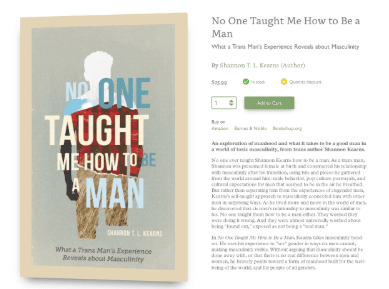
1. No One Taught Me How to Be a Man: What a Trans Man’s Experience Reveals about Masculinity
Shannon T. L. Kearns begins with a problem many trans men recognize: reaching manhood without having been given a trustworthy model for how to inhabit it. Rather than treating masculinity as something inherently corrupt or something that must be performed perfectly, he asks which inherited rules deserve to be kept, rewritten, or discarded.
The book draws on Kearns’s experience as a trans man, writer, and faith leader. That combination gives the discussion an unusual range. Transition is part of the story, but the larger subject is formation—how family, religion, power, shame, and cultural expectations teach people what men are supposedly allowed to feel and do. The book is especially useful for readers who want to claim manhood without reproducing emotional isolation, domination, or contempt for vulnerability.
Kearns writes for cisgender men as well as trans men, which broadens the argument without erasing the distinct insight trans experience brings. His central strength is refusing the false choice between rejecting masculinity altogether and accepting its most damaging traditions. The practical question running through the book is not “Am I man enough?” but “What kind of man am I becoming?” A Publishers Weekly overview provides additional context.
Highlights
- Connects transition, faith, emotional honesty, power, and masculine expectations.
- Treats masculinity as an ethical practice rather than a checklist of traits.
- Offers an affirming starting point for readers who want a healthier relationship with manhood.
What to expect
- Author: Shannon T. L. Kearns
- Best for: Rethinking masculinity without rejecting male identity
- Format: Memoir blended with cultural and spiritual reflection
- Reading level: Accessible
Strengths
- Personal, direct, and grounded in lived experience.
- Useful for trans and cis readers who want to build more accountable forms of masculinity.
Limitations
- It is not a medical-transition guide or a comprehensive history of trans men.
- Readers seeking a secular-only discussion may find the faith material less personally relevant, even though the broader argument extends beyond religion.
Why it ranks first: This is the most direct match for a reader asking how to become a man on purpose. It combines recognition with a challenge: manhood can be affirming, but it also carries choices about how you treat yourself and other people.
Last updated: September 25, 2026
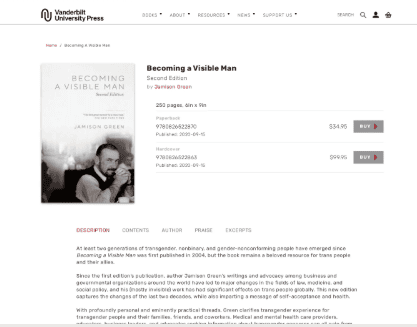
2. Becoming a Visible Man
Jamison Green’s Becoming a Visible Man is both a personal account and a record of transmasculine history. First published in 2004 and substantially updated in a second edition in 2020, it follows one man’s life while documenting the medical, legal, social, and political conditions that shaped trans men’s ability to live openly.
That historical span is the book’s greatest asset. Green writes from a period when trans men were often treated as nearly invisible—even within broader LGBTQ movements—and connects that history to the institutions that still influence healthcare, employment, documentation, relationships, and public recognition. The second edition acknowledges how much has changed while showing how many fundamental questions about belonging and self-acceptance remain.
This is not simply a chronological transition story. Green examines the tension between privacy and visibility, the risks of being known, and the responsibility that can come with public advocacy. He also makes space for family, intimacy, embodiment, and the imperfect process of building a livable life. The publisher’s description of the second edition emphasizes both its historical importance and its continuing relevance.
Highlights
- Combines memoir with trans history, advocacy, health, and social change.
- Explores the costs and possibilities of moving from invisibility to public recognition.
- Provides context for readers who encountered transition in a later era.
What to expect
- Author: Jamison Green
- Best for: Readers wanting a broad foundation in trans men’s lives and history
- Format: Memoir, history, and community resource
- Edition: The second edition adds perspective on developments since the original 2004 publication
Strengths
- Historically significant without becoming emotionally distant.
- Useful to trans readers, loved ones, educators, and professionals.
Limitations
- Some terminology and care frameworks reflect the periods Green lived through.
- Its wide scope means individual topics are not always explored as deeply as they would be in a specialized guide.
Why it ranks second: Few books connect personal transition, community history, and institutional change this effectively. Read it when you want to understand not only one man’s path, but the conditions that made that path visible.
Last updated: September 25, 2026
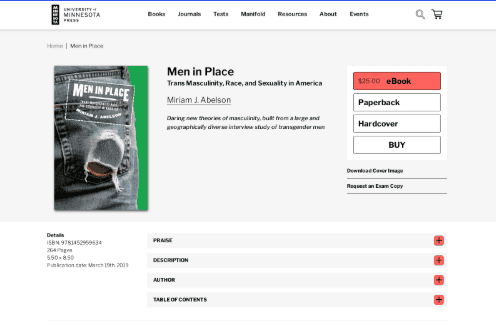
3. Men in Place: Trans Masculinity, Race, and Sexuality in America
Miriam J. Abelson’s Men in Place moves beyond the idea that masculinity means the same thing everywhere. Drawing on a large, geographically diverse interview study of trans men in the United States, Abelson examines how manhood changes across rural areas, suburbs, and cities—and how those places shape what feels safe, expected, or possible.
The book’s intersectional lens is essential. Race, class, sexuality, region, and perceived gender do not operate separately. They affect whether a person is treated as threatening or vulnerable, whether he feels safe in a bathroom or medical setting, and what kind of masculine behavior a community rewards. Abelson uses trans men’s experiences to show that all masculinity is produced in context rather than simply emerging from biology.
One of the book’s most useful contributions is its refusal to classify masculinity as either soft or hard, progressive or traditional. People adjust across settings. A man may need toughness in one environment and emotional openness in another. The University of Minnesota Press overview explains how the book connects these everyday negotiations to larger systems of racism, homophobia, transphobia, and economic inequality.
Highlights
- Shows how masculinity shifts across rural, suburban, and urban environments.
- Centers race, class, sexuality, safety, and institutional power.
- Uses trans men’s accounts to illuminate how masculinity is constructed for all men.
What to expect
- Author: Miriam J. Abelson
- Best for: Intersectional and sociological analysis
- Format: Research-based nonfiction built around interviews
- Reading level: Intermediate to academic
Strengths
- Includes a wider geographic and social range than a single-person memoir can provide.
- Connects intimate experiences to structures of inequality without flattening participants into examples.
Limitations
- The focus is specifically on the United States.
- The academic framework may feel demanding for readers looking primarily for personal narrative or practical advice.
Why it ranks third: This is the strongest choice for understanding why there is no location-neutral or race-neutral version of manhood. It gives readers tools for noticing the social forces behind experiences that can otherwise feel purely personal.
Last updated: September 25, 2026
Also read: Read about eight remarkable trans men
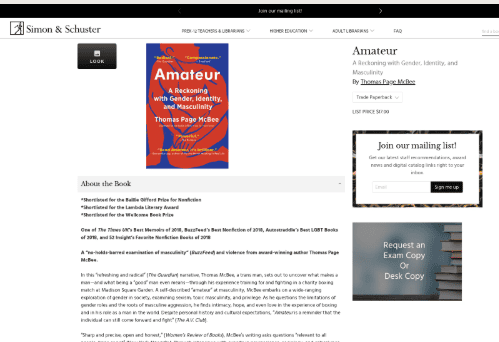
4. amateur: A True Story About What Makes a Man
Thomas Page McBee builds Amateur around training for and participating in a charity boxing match at Madison Square Garden. The physical discipline of boxing gives the book its momentum, but the fight is also a way into harder questions: Why are violence and domination treated as proof of manhood? What happens when someone gains male privilege? Can competition produce intimacy rather than cruelty?
McBee’s perspective as a trans man lets him examine masculine socialization with both proximity and distance. He wants the recognition that comes with being seen as a man, yet he is unwilling to ignore sexism, aggression, and racialized power. Instead of positioning himself outside those systems, he investigates how he participates in them and what accountability could look like.
The result is memoir blended with cultural criticism and reporting. McBee draws on conversations with researchers and experts, but the writing remains rooted in the body: training, fear, pain, adrenaline, and the unexpected tenderness found among fighters. The official publisher description provides more detail about the book’s examination of toxic masculinity, privilege, and hope.
Highlights
- Uses boxing as a concrete way to examine violence, discipline, fear, and belonging.
- Addresses male privilege without reducing masculinity to harm.
- Connects personal experience with wider research about gender and aggression.
What to expect
- Author: Thomas Page McBee
- Best for: Readers interested in strength, vulnerability, violence, and accountability
- Format: Memoir, reporting, and cultural criticism
- Reading level: Accessible to intermediate
Strengths
- Visceral, reflective writing keeps abstract questions grounded in experience.
- Speaks to people of any gender who are trying to understand what makes masculinity healthy or destructive.
Limitations
- Contains discussion of violence, abuse, sexism, and trauma.
- The boxing framework will be compelling for many readers but may feel less immediate to someone seeking transition-specific guidance.
Why it ranks fourth: Amateur reaches beyond identity affirmation and asks what men owe other people. It is especially valuable for readers who want to examine power without treating masculinity itself as irredeemable.
Last updated: September 25, 2026
More books worth reading
The first four books are the strongest general starting points, but they cannot represent the full range of transmasculine experience. The following books add more voices and more demanding analysis. They are not afterthoughts; each becomes the best choice for a particular kind of reader.
5. To Be a Trans Man: Our Stories of Transition, Acceptance and Joy
Edited by Ezra Woodger, this collection is built from interviews with trans men and transmasculine people from the United Kingdom and the United States. That structure matters because no single narrator is asked to represent an entire community. Readers encounter different relationships to appearance, transition, masculinity, family, and belonging.
The conversations address judgment from other people as well as the standards trans people can internalize themselves. They also make deliberate room for gender euphoria, community, openness, and joy. That balance prevents the book from becoming another account in which trans life is defined primarily by suffering or medical intervention.
The publisher describes the collection as a challenge to the idea that there is one correct way to be a man. Its greatest value is companionship: a reader can recognize pieces of himself across several lives without needing any one story to match perfectly.
- Best for: Readers seeking multiple relatable voices and an affirming tone
- Format: Edited interview collection
- Strength: Balances difficulty with acceptance, community, and gender euphoria
- Consideration: Interviews offer breadth, but each individual story receives less space than a full memoir would
6. Manning Up: Transsexual Men on Finding Brotherhood, Family & Themselves
Edited by Zander Keig and Mitch Kellaway, Manning Up collects personal narratives from twenty-seven North American trans men across different ages, ethnicities, classes, abilities, spiritual traditions, and stages of life. The contributors write as fathers, sons, brothers, husbands, partners, friends, and mentors—not simply as people undergoing transition.
That emphasis makes the anthology especially useful for thinking about relationships. Its subjects include parenting and childbirth, gay male sexuality, racism, religion, family bonds, embodiment, and community responsibility. The voices do not resolve into one approved version of manhood, and some essays are more challenging or painful than others.
The word transsexual in the title reflects the language chosen when the book was published in 2014 and may not be the term every reader uses today. That does not erase the collection’s value, but it is worth approaching the wording historically rather than assuming it describes every contributor or present-day trans man. The publisher’s overview details the anthology’s range of contributors and subjects.
- Best for: Readers interested in family roles, community, and varied adult lives
- Format: Multi-author personal essay anthology
- Strength: Broad social, cultural, and generational range
- Consideration: Language and some perspectives reflect the book’s publication era
7. Masculinity in Transition
K. Allison Hammer’s Masculinity in Transition is the most academically demanding book on this list. Rather than centering a conventional transition narrative, Hammer analyzes literature, film, television, performance, and transgender poetics to ask how masculinity supports—or disrupts—larger systems of power.
The book traces toxic masculinity through histories of settler colonialism, racial capitalism, nationalism, and political fraternity. It also refuses the comforting assumption that queer or trans masculinity is automatically liberatory. Trans and queer people can reproduce dominant hierarchies, even while their lives also create possibilities for resisting them.
Hammer’s alternative is found in what the book calls unruly alliances: cultural works and relationships that loosen masculinity’s attachment to domination, whiteness, heterosexuality, and invulnerability. The University of Minnesota Press description outlines the book’s wide archive and its effort to imagine masculinity through care, permeability, and unexpected solidarity.
- Best for: Students, scholars, and readers comfortable with queer and cultural theory
- Format: Academic cultural criticism
- Strength: Provides the deepest analysis of masculinity as a political and cultural system
- Consideration: Dense terminology and close readings make it less accessible as a first book on the subject
How to choose the right book about trans masculinity
The right starting point depends less on which book is supposedly “best” and more on what you need from reading right now. A book that offers recognition during a difficult transition period serves a different purpose from one that challenges you to examine privilege, race, or institutional power.
Choose according to the question you are carrying
- “What kind of man do I want to become?” Start with No One Taught Me How to Be a Man.
- “Where do trans men fit in our history?” Choose Becoming a Visible Man.
- “Why does masculinity feel different depending on where and how I live?” Read Men in Place.
- “How can I face violence and male privilege without abandoning manhood?” Try Amateur.
- “I need to hear several people describe lives like mine.” Choose To Be a Trans Man or Manning Up.
- “I want a rigorous critique of masculinity as a system.” Read Masculinity in Transition.
Consider the kind of reading experience you can handle
Memoirs usually move quickly and offer emotional recognition, but one life cannot represent everyone. Anthologies provide more variety, though their essays may feel uneven because the voices and styles differ. Research and theory can reveal patterns that personal stories cannot, but they require more concentration and may not provide the immediate reassurance some readers want.
Content also matters. Several books discuss violence, abuse, discrimination, dysphoria, racism, or social isolation. Reading slowly, checking content notes, and pausing when a chapter becomes overwhelming are valid choices. A useful book does not need to be consumed in one sitting to have an impact.
Finding True Masculinity can act as a companion to this reading. Use the books to gather language and perspective, then bring those ideas back to your own values, relationships, boundaries, and definition of manhood.
Keep exploring masculinity on your own terms. Finding True Masculinity offers lived-experience guidance, stories, and resources for the questions books can begin but cannot answer for you.
Frequently Asked Questions
What is the best first book about trans men and masculinity?
No One Taught Me How to Be a Man is the strongest first choice if your main question is how to build a healthy relationship with manhood. Choose Becoming a Visible Man instead if you want history and a broader account of trans men’s lives, healthcare, visibility, and advocacy.
Should I begin with a memoir, anthology, or academic book?
Begin with a memoir when you want emotional recognition and a sustained personal voice. Choose an anthology when you need proof that trans men’s lives can look radically different from one another. Academic books are most useful when you want to understand recurring social patterns, institutions, and systems of power.
Do these books represent every transmasculine experience?
No. The list includes different formats and perspectives, but seven books cannot represent every race, culture, disability, class position, sexuality, age, nationality, or transition path. Treat the collection as a set of entry points rather than a definitive map of transmasculine life.
Are these books useful for people who do not medically transition?
Yes. Although some authors and contributors discuss hormones, surgery, or other medical care, the larger questions involve identity, relationships, social recognition, embodiment, community, and self-defined masculinity. No medical procedure is required to benefit from those discussions—or to be a man.
Can partners, relatives, and supportive allies read these books?
Yes. Becoming a Visible Man, To Be a Trans Man, and Manning Up are especially useful for readers who need exposure to varied lived experiences. Allies should read to understand rather than to turn one author’s story into a standard that every trans man is expected to follow.
Why include books that criticize masculinity on a transmasculine reading list?
Affirming trans men does not require pretending masculinity is untouched by power. Books such as Amateur, Men in Place, and Masculinity in Transition make room for both truths: being recognized as a man can be lifesaving, and men still have responsibilities within systems shaped by sexism, racism, class, and violence.