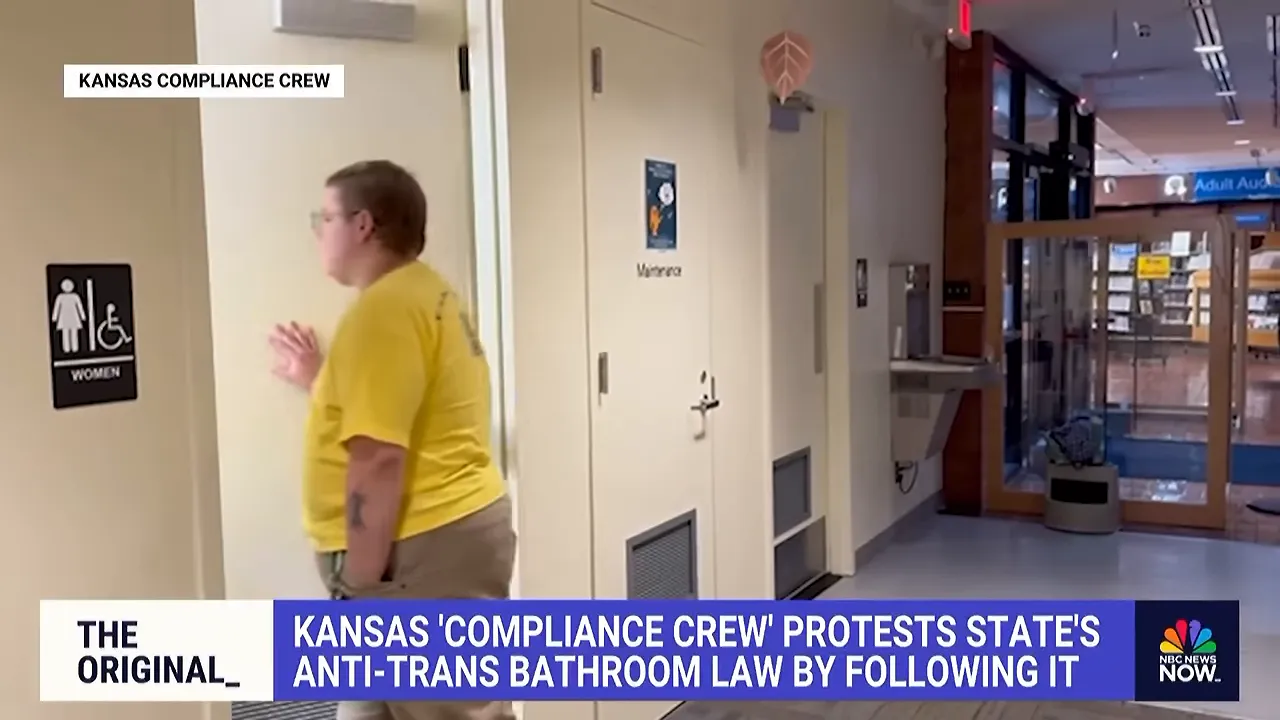
A group of transgender men in Kansas is challenging the state’s bathroom restrictions through an unusual strategy: using the women’s restrooms the law directs them to use.
Calling themselves the Kansas Compliance Crew, the roughly dozen-member group wants to expose a contradiction. A law promoted as a way to exclude men from women’s bathrooms instead requires these men to enter them because of their sex assigned at birth.
Their actions also raise a practical question: what happens when someone follows a bathroom law but other people assume they are breaking it?
Key Takeaways
- The Kansas Compliance Crew consists of trans men protesting restroom restrictions by following them.
- The reported law bases covered restroom access and state-document sex markers on sex assigned at birth.
- Members report confrontations despite complying, while separate litigation challenges driver’s license invalidations.
The Contradiction Behind the Kansas Compliance Crew’s Protest
The group’s approach depends on a distinction often lost in bathroom-policy debates: transgender men are men, but a rule based on sex assigned at birth directs them to women’s facilities.
Members interviewed by NBC News said they had used men’s restrooms for years, generally without attracting attention. Under the Kansas law described in that reporting, continuing that routine could expose them to legal consequences in covered public facilities.
Instead, they began using women’s restrooms at locations including libraries, swimming pools, and the Kansas State Fair. Their purpose is not to disregard the restriction but to make its consequences visible.
For readers unfamiliar with the distinction between gender identity and sex assigned at birth, this guide to understanding trans men respectfully provides useful background.
Why comply rather than deliberately break the law?
Members said they wanted to oppose the measure without taking the risk of violating it. Compliance became their method of protest.
That makes the strategy different from civil disobedience that intentionally breaks a rule. The Compliance Crew’s argument is that the rule itself produces the result its supporters said they wanted to prevent: men using women’s restrooms.
What the Kansas Bathroom Law Requires
The measure, identified as SB 244, became law after Republican lawmakers overrode Democratic Governor Laura Kelly’s veto in February, according to NBC News.
The reporting describes several connected requirements and enforcement mechanisms:
- Restroom access based on sex assigned at birth: Covered facilities in publicly owned buildings must be used according to that classification rather than gender identity.
- State-document requirements: State-issued documents, including driver’s licenses and birth certificates, must reflect sex assigned at birth.
- Penalties for repeated violations: Repeated violations may lead to fines or criminal charges.
- Private lawsuits: A provision allows private individuals to sue an alleged violator for $1,000.
Scope matters. The restroom restrictions described here concern publicly owned facilities. That is not the same as saying every restroom in every privately owned business is covered.
These details explain the dispute as reported, not the latest outcome of litigation or every exception in the statute. Anyone making decisions about restroom access, identification documents, or potential liability should verify current Kansas requirements and seek qualified legal advice. This overview of legal guidance for transmasculine people offers an additional starting point.
Following the Rule Has Not Prevented Confrontations
The Compliance Crew’s experiences highlight a gap between legal compliance and how people react in shared spaces.
One member described being questioned about whether he knew he had entered a women’s restroom. At the state fair, members reported hostile looks and a man shouting questions about whether they were men.
Ray Vieux described the difficulty of responding while trying to stay safe and leave the situation. Vieux also said that even police sometimes appeared unfamiliar with the law or uncertain about enforcement.
Those accounts illustrate the group’s central concern: a person’s appearance does not tell a bystander whether that person is complying with a birth-sex-based restriction. Someone perceived as a man in a women’s restroom may be there precisely because the law requires it.
Why the private-lawsuit provision matters
The law’s private-enforcement mechanism adds another source of concern. Critics describe it as encouraging people to scrutinize and challenge one another’s restroom use.
ACLU attorney Harper Seldin argues that this approach fosters conflict between community members. The Compliance Crew’s reported encounters show how suspicion can arise even when a person is trying to follow the rule.
A threatened or filed lawsuit is also different from a court finding that someone violated the law. The existence of a private claim should not be confused with an automatic determination of liability.
The Driver’s License Dispute and Constitutional Challenge
The controversy extends beyond bathrooms. NBC News reported that Seldin represents six people suing Kansas after the state invalidated their driver’s licenses.
Seldin’s constitutional argument concerns whether Kansas may exclude people from a space because of who they are, rather than because of their conduct. He contends that such exclusion conflicts with the Kansas Constitution.
That is a legal argument, not a reported final court ruling. The reporting does not establish the lawsuit’s ultimate outcome.
Kansas Attorney General Kris Kobach has defended the law in court. NBC News said he did not respond to detailed questions. State Senator Ty Masterson, identified in the reporting as the law’s author, also did not respond to interview requests. In a public statement after the veto override, Masterson characterized the measure as a common-sense protection for women and girls.
How Kansas Fits Into the Wider Bathroom-Law Debate
At the time of NBC News’s reporting, the Movement Advancement Project counted 21 states with restrictions affecting transgender people’s access to facilities in government-owned buildings, including nine with broader bathroom bans.
Those figures are a snapshot, not a permanent count. Restrictions differ in scope, and legal developments can change their effect. The Movement Advancement Project’s bathroom-ban tracker provides additional state-by-state context.
The Kansas protest brings attention to trans men’s experiences within that broader debate. Members also describe their actions as solidarity with transgender women, rather than an effort focused only on their own access.
What the Protest Makes Clear
The Kansas Compliance Crew is testing the law’s premise through ordinary conduct. Its members say they intend to continue demonstrating that compliance can place men in women’s restrooms while exposing those same men to suspicion and confrontation.
The key distinction is between what a rule requires, what a bystander assumes, and what actually constitutes a violation. The group’s protest shows why those three things should not be treated as interchangeable.
Frequently Asked Questions
What is the Kansas Compliance Crew?
The Kansas Compliance Crew is a group of roughly a dozen transgender men who oppose the state’s bathroom law by using the women’s facilities it directs them to use based on sex assigned at birth.
Why are trans men using women’s bathrooms in Kansas?
Members say they are complying with the law while demonstrating its consequences. They had previously used men’s restrooms, often without incident, but the reported restriction directs them to women’s facilities in covered public buildings.
Does the Kansas law affect driver’s licenses?
Yes. NBC News reported that the law requires state-issued documents to reflect sex assigned at birth and that Kansas invalidated some transgender people’s driver’s licenses. Six affected people were represented by an ACLU attorney in a lawsuit against the state.
Does complying with the bathroom law eliminate safety concerns?
No. Members reported questioning, hostile looks, and shouting while using the facilities the law required. Their experiences show that legal compliance does not necessarily prevent confrontation.