

Giving yourself a testosterone injection can feel intimidating at first, especially if you have needle anxiety. A consistent routine, the right supplies, and hands-on training from a prescribing clinician can make weekly subcutaneous, or SubQ, testosterone shots more manageable.
This guide explains the practical basics of subcutaneous testosterone injections for transmasculine HRT, including supplies, site rotation, needle terminology, aftercare, and when to contact a medical professional. It is educational information, not a substitute for the technique, dose, needle size, or medication instructions provided by your clinician.
Key Takeaways
- SubQ testosterone injections deliver medication into fatty tissue, while IM injections go into muscle.
- Use new sterile equipment, clean and dry the skin, and rotate approved injection sites.
- Needle gauge works in reverse: higher gauge numbers indicate thinner needles.
- Ask a clinician for injection training and seek medical help for severe or unusual symptoms.
Disclaimer: Some of the links in this post are Amazon affiliate links. This means that if you click through and make a purchase, I may earn a small commission at no extra cost to you. I want to emphasize that I only recommend products that I personally use, trust, or believe will be valuable to you. My goal is to provide resources that align with the mission of this blog—to support and uplift the trans masculine community.
Table of Contents
- What Is a Subcutaneous Testosterone Injection?
- Start With Clinical Training, Not Guesswork
- SubQ Testosterone Shot Supplies Checklist
- Understanding Needle Gauge and Length
- How to Prepare for a Testosterone Shot
- Choosing and Rotating SubQ Injection Sites
- SubQ Injection Technique Basics
- What Is Normal After a Testosterone Injection?
- Safe Sharps Disposal Matters
- Common Testosterone Injection Mistakes to Avoid
- How to Get Over Needle Fear for Testosterone Shots
- Bottom Line
What Is a Subcutaneous Testosterone Injection?
A subcutaneous injection places medication in the fatty layer directly under the skin. This differs from an intramuscular injection, often shortened to IM, which delivers medication into muscle tissue.
SubQ testosterone is commonly chosen because it generally uses a shorter, thinner needle than an IM injection. Many people find that more comfortable for self-injection. Both injection routes can be part of prescribed testosterone therapy, but the right route, injection site, dose, and schedule are individual medical decisions.
Testosterone injections are only one option for gender-affirming hormone therapy. Some people use daily testosterone gel, while others prefer a weekly injection routine. The best fit often comes down to prescription coverage, comfort with injections, daily routine, and how a person responds to treatment.
For a broader explanation of changes that may occur on testosterone, see this testosterone resource for transmasculine people.
Start With Clinical Training, Not Guesswork
Before doing an injection independently, ask the clinician who prescribed testosterone to demonstrate the technique and supervise your first injection if possible. They can confirm:
- Your prescribed dose and schedule
- Whether your medication is intended for SubQ or IM use
- The correct syringe and needle setup
- Approved injection sites for your body and prescription
- How to handle medication vials and dispose of sharps in your area
Do not copy another person’s dose, syringe markings, or vial practices. Testosterone concentration and prescribed volume vary, and a vial labeled for single use should be handled according to its label and your pharmacist’s or prescriber’s instructions.
SubQ Testosterone Shot Supplies Checklist
Set up everything you need before starting. Having supplies ready reduces rushing, limits contamination, and can make needle anxiety easier to manage.
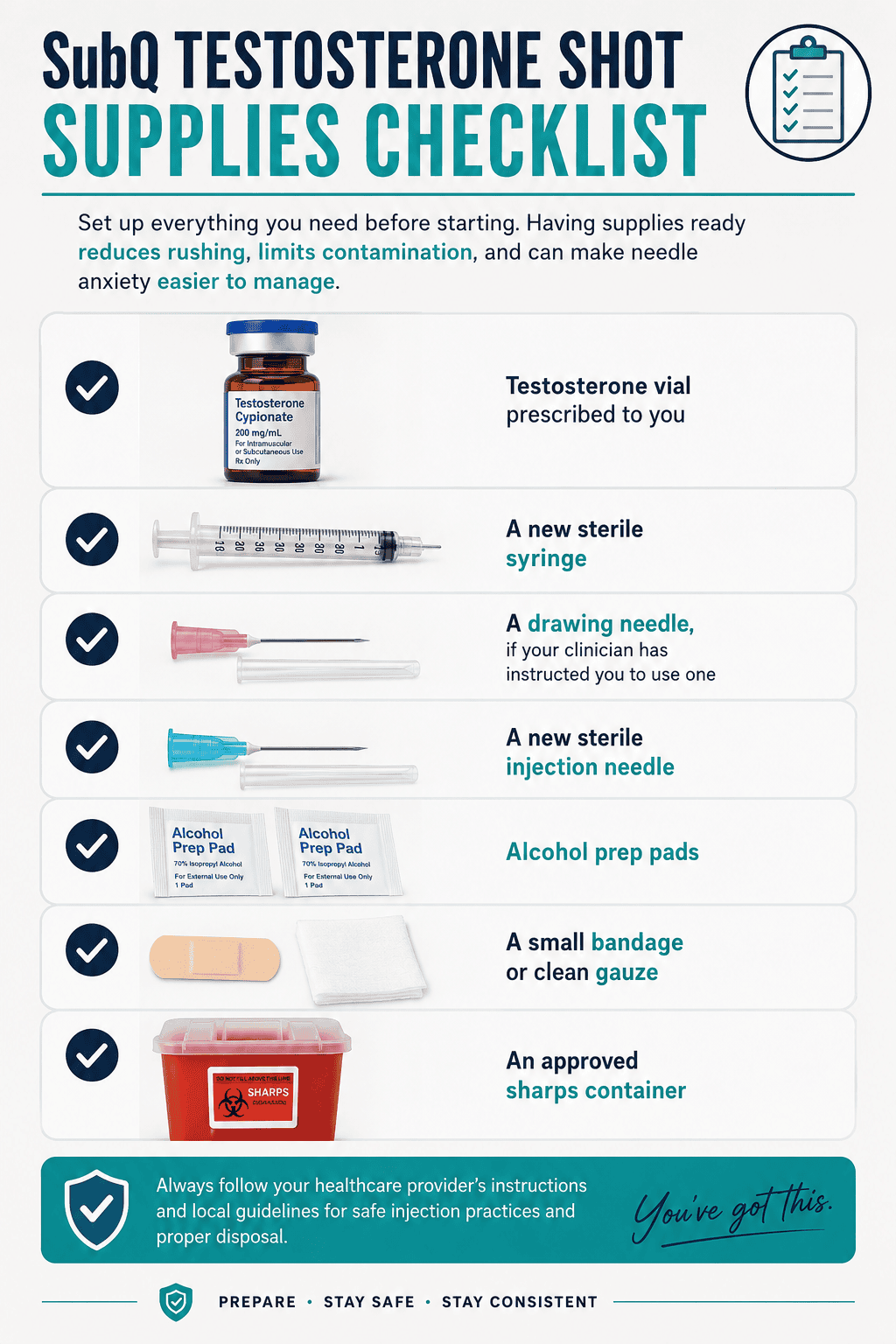
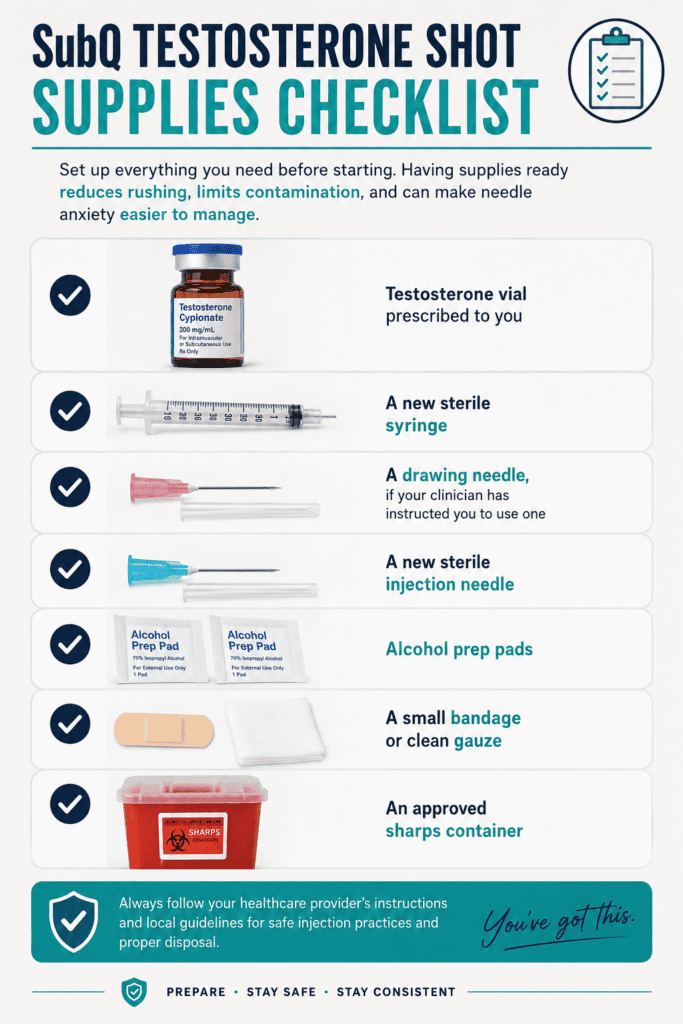
- Testosterone vial prescribed to you
- A new sterile syringe
- A drawing needle, if your clinician has instructed you to use one
- A new sterile injection needle
- Alcohol prep pads
- A small bandage or clean gauze
- An approved sharps container
Wash your hands before handling the vial, syringe, or needles. Use a clean, prepared surface rather than placing sterile supplies directly on an unclean counter.
Why use a separate drawing needle and injection needle?
Some testosterone injection setups use two needles. A wider drawing needle can make it easier to pull a thicker, oil-based medication from the vial. The needle is then changed before injecting. This avoids injecting with a needle that may have dulled while passing through the vial stopper.
Needle connections vary. Some syringes use a twist-lock connection, while others use a push-on connection. Use only equipment that fits your prescribed setup, and keep the sterile needle protected until it is time to use it.
Understanding Needle Gauge and Length
Needle labels usually include a gauge and a length. For example, “25G x 5/8” means a 25-gauge needle that is five-eighths of an inch long.
- Gauge: A lower gauge number means a wider needle. A higher gauge number means a thinner needle.
- Length: The second number is the needle length, usually measured in inches.
A wider needle may be useful for drawing viscous medication, while a thinner and shorter needle is often used for SubQ injections. The source material describes 18G x 1 inch as a common drawing-needle example and 25G x 5/8 inch as a common injection-needle example. It also notes that SubQ injection needle choices may fall around 25G to 31G and 3/8 to 5/8 inch.
These are examples, not universal instructions. Your prescriber or pharmacist should confirm the supplies appropriate for you.
How to Prepare for a Testosterone Shot
A simple repeatable routine can reduce stress and missed doses. Some people prefer doing their shot earlier in the day simply because it is easier to remember and avoids spending the whole day anticipating it.
1. Check the prescription and medication
Confirm that you have the correct vial and prescribed dose. Do not estimate a dose or intentionally overfill the syringe to compensate for medication left in the needle. If you are unsure how to read your syringe or what volume to draw, stop and contact your pharmacy or prescriber.
Some people warm an oil-based testosterone vial between their hands or against their body for a few minutes because warmer oil can be easier to draw and inject. Do not overheat the medication. Follow storage instructions on the prescription label and ask a pharmacist if you have questions.
2. Clean the vial stopper
After removing the vial cap when applicable, wipe the rubber stopper with an alcohol prep pad and allow it to dry. Avoid touching the cleaned stopper afterward.
3. Draw up the medication as trained
Use a new sterile needle to access the vial. Following your clinician’s instructions, draw the prescribed amount into the syringe and remove visible air from the syringe before injection. If you were instructed to use a separate drawing needle, replace it with a new injection needle before injecting.
Keep the injection needle sterile. Avoid touching the needle or allowing it to contact a surface. If it does, replace it with a new one.
Choosing and Rotating SubQ Injection Sites
Common SubQ injection areas include the abdomen and the upper outer thigh, but site guidance should come from your clinician. The outer thigh can be a practical option because it is easy to reach and allows a person to gently pinch tissue if that is part of their instructed technique.
Most importantly, rotate injection sites. Repeatedly injecting in exactly the same spot can contribute to soreness and irritated tissue. A simple rotation system is to alternate sides each week, such as left thigh one week and right thigh the next, while also varying the exact spot within the approved area.
Avoid injecting into skin that is bruised, swollen, scarred, irritated, infected, or unusually tender. If you are unsure whether a spot is suitable, choose another approved location or ask your care team.
Clean and dry the skin
Use an alcohol pad to clean the chosen site, then let the skin air-dry completely. Injecting before the alcohol dries can cause unnecessary stinging.
SubQ Injection Technique Basics
Follow the exact angle and pinch technique you were taught. The source material describes SubQ injections as commonly being performed at about a 45-degree angle with a short needle, compared with an IM injection, which commonly uses a longer needle and a 90-degree angle.
Many people find it helpful to pinch a fold of fatty tissue, which can help isolate the subcutaneous layer. Keep the needle bevel oriented as instructed by your clinician. Insert the needle in a controlled motion, inject steadily, and remove it as trained.
Oil-based testosterone can move slowly through a thin needle. There is no need to force the plunger. A slow, steady injection is normal. After finishing, some people briefly pause before removing the needle, which may reduce medication leakage from the injection site.
If injection anxiety makes hesitation harder, build a calming ritual around the appointment with yourself. Prepare supplies in advance, sit in a stable position, use music or a grounding exercise, and keep the process consistent from week to week.
What Is Normal After a Testosterone Injection?
A tiny spot of blood, a small bead of medication, or brief tenderness can happen after an injection. Apply gentle pressure with clean gauze or a bandage if needed. Do not reuse the alcohol pad that cleaned the skin.
Track your injection site if you are prone to soreness, redness, or lumps. This gives you useful details to share with a clinician if a reaction keeps occurring.
When to contact a clinician
Contact your prescriber promptly if you develop repeated or worsening redness, itchiness, hives, or other signs of a possible reaction. Reactions may relate to ingredients in the formulation, including a carrier oil, rather than testosterone itself. A clinician can determine whether a different formulation, such as testosterone cypionate or enanthate, is appropriate.
Seek urgent medical care for severe symptoms after an injection, including difficulty breathing, fainting, severe dizziness, chest symptoms, a racing heart, or a sudden coughing episode combined with a metallic taste and feeling unwell. A small dot of blood alone does not necessarily mean a serious problem, but severe or unusual symptoms should never be ignored.
Safe Sharps Disposal Matters
Needles and syringes should go directly into an approved sharps container after use. Never put loose needles into household trash, recycling, or a public bin.
Some areas allow a heavy, puncture-resistant plastic container as a temporary sharps container, while others have specific disposal rules. Local rules may also differ on whether the entire syringe must be placed in the container. Check your local public-health guidance, pharmacy, or clinician’s office before disposal.
The FDA guidance on sharps disposal containers is a useful starting point for understanding safe storage and disposal.
Common Testosterone Injection Mistakes to Avoid
- Skipping training: Ask for a demonstration rather than trying to learn entirely alone.
- Using the drawing needle to inject: If prescribed supplies include two needles, change to a fresh injection needle.
- Injecting through wet alcohol: Let the skin dry first.
- Reusing needles or syringes: Every injection requires new sterile equipment.
- Using the same spot repeatedly: Rotate sides and locations within approved injection areas.
- Ignoring vial instructions: Follow the vial label and advice from your pharmacist or prescriber, particularly for single-use medication.
- Throwing sharps in regular trash: Use an appropriate sharps container and follow local disposal rules.
How to Get Over Needle Fear for Testosterone Shots
Needle fear is common, and it does not mean that self-injections are impossible. Familiarity can help. Gradual exposure to the idea of injections, reviewing clinician-approved education, and practicing the setup without injecting can make the steps feel less unfamiliar over time.
Try to separate preparation from the injection itself. Lay out supplies, wash your hands, and prepare the area before you are sitting with an uncapped needle. Keeping a predictable order reduces the number of decisions you need to make when you are nervous.
If self-injection continues to feel unmanageable, ask your clinician about alternatives. Depending on your prescription and availability, options may include help from a trusted trained person, a different testosterone delivery method, or an autoinjector. You do not need to force yourself through a method that is causing significant distress without discussing it with your care team.
For broader support around transition, healthcare navigation, and well-being, explore these transmasculine resources and support options.
Bottom Line
A successful SubQ testosterone routine is less about doing it perfectly and more about following your prescription, using sterile single-use supplies, rotating approved sites, and knowing when to ask for help. Once the process becomes familiar, a weekly shot can become one small, structured part of gender-affirming care.
|
Frequently Asked Questions About Testosterone Shots
Is SubQ testosterone as effective as IM testosterone?
Both routes can be used for prescribed testosterone therapy. The appropriate route depends on your prescription and medical guidance. Discuss any concerns about changes, bloodwork, comfort, or hormone levels with your prescriber.
What needle size is used for subcutaneous testosterone?
Needle size depends on the prescription and clinician preference. Examples discussed for SubQ testosterone include shorter needles in the 3/8 to 5/8 inch range and gauges around 25G to 31G. Confirm the correct size with your clinician or pharmacist before buying supplies.
Can I inject testosterone in my thigh subcutaneously?
The upper outer thigh may be an approved SubQ site for some people. Ask your clinician to identify the correct areas for your body and show you how to rotate them safely.
Is a little blood after a testosterone shot normal?
A small spot of blood can occur after an injection. Apply gentle pressure with clean gauze or a bandage. Contact a clinician if bleeding is persistent or if you experience severe, unusual, or concerning symptoms.
What if I think I am allergic to my testosterone injection?
Itchiness, redness, or hives should be discussed with your prescriber promptly. A clinician can assess whether the reaction may relate to the medication formulation or carrier oil and whether another option is appropriate.