By Gabriel
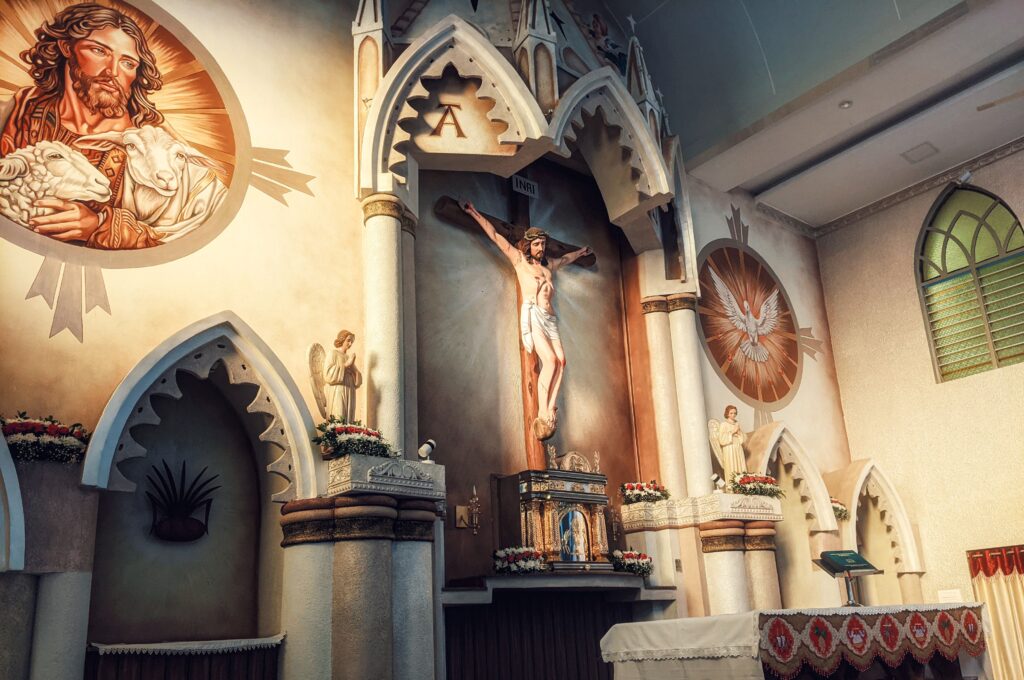
I am a trans man, and I still go to Mass.
For some Catholics, that sentence is a contradiction. For some queer people, the word Catholic carries enough pain that they cannot understand why I would stay. I understand both reactions.
I’m 45, Mexican American, and from El Paso. I grew up Catholic in the way you grow up with weather: it was everywhere. My grandmother kept candles beside a picture of Our Lady of Guadalupe. My mother crossed herself before getting on the freeway. There were rosaries in drawers, saints’ cards in wallets, Spanish prayers at the kitchen table, and Mass every Sunday.
Faith was never only a church building. It was food delivered to grieving families. It was neighbors taking up a collection when someone got sick. It was lighting a candle for somebody who needed help. It was the language my family used for love, fear, gratitude, and loss.
That is why leaving was never simple.
The Truth I Couldn’t Pray Away
I did not have language for being trans when I was young. I only knew that being called a girl felt wrong in a way I could not explain. I knew the life people pictured for me felt like clothing that did not fit. I prayed for the discomfort to go away because I thought that was what a faithful person was supposed to do.
I believed God had made me wrong.
For years, I tried to become acceptable. I went to Mass, prayed the rosary, volunteered, and told myself that if I were more obedient, more grateful, or more ashamed, I would eventually become the person everyone expected.
Instead, I became tired.
There is a loneliness in believing that the thing you most need to say to God is the thing God will reject. I learned to pray around the truth. I called it confusion, temptation, a burden—anything except what it was.
Eventually, I could not keep doing that.
My transition did not start with confidence. It started when I understood that I could not spend the rest of my life pretending to be someone else. I did not wake up one day with every answer. I reached a point where living dishonestly hurt more than the possibility of being rejected.
That did not make the decision easy. In a close family, every change has an audience. I worried about what people would say, what they would assume, whether they would think I was abandoning them along with the role they had assigned me. I worried about disappointing people I loved.
God Did Not Leave
When I came out as a man, I expected God to leave first.
I had heard enough messages—some direct, some implied—to think that there was no room for someone like me in the Church. I had heard people talk about gender as if trans people were an idea or a threat, not their neighbors. I had sat through homilies that made me feel invisible and exposed at the same time.
But when I finally spoke honestly in prayer, God did not leave.
At first, I prayed angrily. Then I prayed honestly. I told God I was tired of being afraid. I told God I did not know whether the Church had room for me. I told God I was not willing to hate myself in exchange for belonging.
Over time, I came to believe that the God I feared was not the God I knew in prayer.
The God I know does not ask me to become less truthful in order to be loved.
That belief did not come from a perfect answer or a single conversation. It came gradually: in the quiet after prayer, in the people who used my name without hesitation, in the feeling of relief that arrived when I stopped asking permission to exist. Faith became less about certainty and more about honesty.
Why I Still Go
Mass is complicated for me. Some Sundays, I feel completely at home: the familiar songs, the rhythm of standing and kneeling, the quiet before the service begins. Other days, I hear language about “family,” gender, or “the culture,” and I feel myself tense up.
I do not pretend that harm done in the name of faith does not matter. It does. Trans people should not have to endure rejection, silence, or shame in order to participate in spiritual life. The Church needs to listen more carefully and recognize that trans people are not theological arguments. We are people with families, histories, grief, faith, and a need to belong without being asked to disappear.
But I have stopped treating other people’s discomfort as proof that I do not belong.
My faith is not a political argument. It is where I bring my grief, my gratitude, and the people I love. It is where I light candles for the sick and the dead. It is where I remember that mercy is supposed to mean something.
Making peace with God did not mean making peace with every harmful thing people have said in God’s name. It meant separating God from the voices that taught me shame. It meant keeping what led me toward compassion and letting go of what demanded fear.
I still go to Mass. I still pray. I still believe in making room at the table.
And I believe God has room for me, too.
Gabriel. A trans man from El Paso. Mexican American. Catholic. Still here.